About this ebook
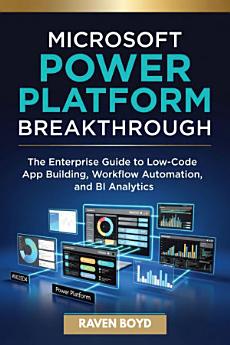
The book begins by establishing a mental model of the Power Platform, explaining its core components, connectors, environments, licensing, and the relationship between citizen developers and developers. From there, the focus turns to Dataverse and the data models that support durable business solutions, covering tables, columns, relationships, security, business rules, and modeling decisions.
Readers then move into application development with Power Apps canvas apps, learning how to think in Power Fx, design interfaces, manage variables and collections, connect applications to business data, and build solutions that work for users. Model-driven apps receive coverage, showing how structured Dataverse models can drive scalable applications.
The automation chapters explore Power Automate and show how to create reliable flows, work with conditions, loops, expressions, approvals, and system integrations. The book goes further into robotic process automation, desktop flows, intelligent document processing, and process mining, demonstrating how organizations can tackle repetitive work that traditional workflows cannot reach.
The Power BI section turns data into insight through data connections, Power Query, modeling, relationships, DAX, report design, sharing, and refresh strategies. The chapter brings the platform together with governance, security, data loss prevention, application lifecycle management, monitoring, and responsible AI.
Throughout the book, examples, exercises, case studies, and reusable techniques help readers progress from experiments to business solutions. Whether you are a business professional, analyst, citizen developer, IT practitioner, or technical architect, this guide provides a structured path to designing, automating, analyzing, securing, and improving enterprise solutions with Microsoft Power Platform.