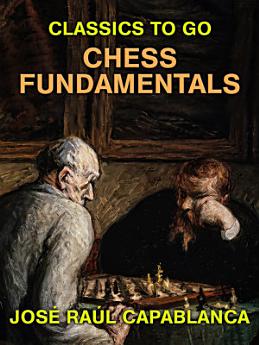
Chess Fundamentals
Jul 2021 · Otbebookpublishing
Ebook
261
Pages
family_home
Eligible
info
About this ebook
Excerpt: "In chess the tactics may change but the strategic fundamental principles are always the same, so that Chess Fundamentals is as good now as it was thirteen years ago. It will be as good a hundred years from now; as long in fact as the laws and rules of the game remain what they are at present. The reader may therefore go over the contents of the book with the assurance that there is in it everything he needs, and that there is nothing to be added and nothing to be changed. Chess Fundamentals was the one standard work of its kind thirteen years ago and the author firmly believes that it is the one standard work of its kind now."
Excerpt: "In chess the tactics may change but the strategic fundamental principles are always the same, so that Chess Fundamentals is as good now as it was thirteen years ago. It will be as good a hundred years from now; as long in fact as the laws and rules of the game remain what they are at pr...
Discover more
About the author
José Raúl Capablanca (1888-1942) was a Cuban chess prodigy whose influence extended far beyond the 64 squares of the chessboard. Born in Havana, Capablanca's genius was evident from a young age; he learned the game by watching his father play and quickly outpaced him. By the age of 13, he had defeated the Cuban national champion, setting the stage for a career that would make him one of the most formidable chess players in history.Capablanca's style was revolutionary for its simplicity and elegance. He eschewed the complex, often convoluted strategies favored by his contemporaries, advocating instead for clarity and precision. This approach not only made him a formidable opponent but also a beloved figure in the chess community, earning him the nickname "The Chess Machine."His tenure as World Chess Champion from 1921 to 1927 was marked by a string of impressive victories and an unbeaten streak that lasted for eight years. However, his reign was not without controversy. Capablanca's rivalry with Alexander Alekhine, who eventually dethroned him, was fraught with tension and drama, captivating the chess world and beyond.Capablanca's influence extended to contemporary writers and thinkers who admired his intellectual rigor and strategic mind. His ideas about clarity and efficiency found echoes in various fields, from business to military strategy, making him a figure of enduring relevance.Beyond the chessboard, Capablanca was a diplomat and a cultural ambassador for Cuba, embodying the nation's intellectual and artistic spirit. His life and career continue to inspire, offering timeless lessons in strategy, elegance, and the relentless pursuit of excellence.
José Raúl Capablanca (1888-1942) was a Cuban chess prodigy whose influence extended far beyond the 64 squares of the chessboard. Born in Havana, Capablanca's genius was evident from a young age; he learned the game by watching his father play and quickly outpaced him. By the age of 13, he had def...
Rate this ebook
Tell us what you think.
Reading information
Smartphones and tablets
Install the Google Play Books app for Android and iPad/iPhone. It syncs automatically with your account and allows you to read online or offline wherever you are.
Laptops and computers
You can listen to audiobooks purchased on Google Play using your computer's web browser.
eReaders and other devices
To read on e-ink devices like Kobo eReaders, you'll need to download a file and transfer it to your device. Follow the detailed Help Center instructions to transfer the files to supported eReaders.