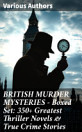
British Murder Mysteries - Ultimate Collection: Classic Whodunits: An Anthology of Victorian and Twentieth-Century British Detective Fiction
Arthur Conan Doyle · Ernest Bramah · Arthur Morrison · Agatha Christie · Wilkie Collins · Thomas W. Hanshew · Edgar Wallace · Frank Froest · J. S. Fletcher · C. N. Williamson · A. M. Williamson · R. Austin Freeman · E. W. Hornung · G. K. Chesterton · H. C. McNeile · Victor L. Whitechurch · Rober Barr · Isabel Ostander
May 2022 · DigiCat
Ebook
22968
Pages
family_home
Eligible
info
About this ebook
British Murder Mysteries - Ultimate Collection is an unparalleled anthology that celebrates the grandeur of the classic English detective story—an art form woven into the rich tapestry of British literature. Set against the foggy, gas-lit backstreets of Victorian and Edwardian England to the garish modernity of the early 20th century, this collection offers a plethora of styles and settings. Revealing the shadowy nooks of the human psyche, each tale explores themes of justice, moral ambiguity, and the eternal dance between right and wrong. The anthology is notable for its inclusion of seminal, thrilling adventures that deliver both rational deduction and psychological suspense. Helmed by literary giants such as Arthur Conan Doyle and Agatha Christie, the anthology features the works of renowned and beloved authors from the golden age of detective fiction. Contributing to the great tradition of mystery writing, these authors come from diversified backgrounds, each bringing their unique perspective to the narrative. This confluence of voices resonates with the social changes and literary experimentation of their times—rich in storytelling prowess and emblematic of the cultural zeitgeist of Britain from late 19th century to post World War I era. This collection serves as an essential compendium for any aficionado of the murder mystery genre, offering an immersive portal into a bygone era. It provides an expansive exploration of complex themes, vivid character portrayals, and intricate plots within a single volume. Readers are invited to traverse the labyrinthine narratives crafted by masters of the mystery genre, unlocking layers of insight with each tale. Whether read for entertainment, education, or enlightenment, this anthology promises a timeless dialogue with the classic detective fiction canon.
British Murder Mysteries - Ultimate Collection is an unparalleled anthology that celebrates the grandeur of the classic English detective story—an art form woven into the rich tapestry of British literature. Set against the foggy, gas-lit backstreets of Victorian and Edwardian England to the gari...
Discover more
About the author
Sir Arthur Ignatius Conan Doyle (1859–1930) was a British writer and medical doctor, renowned for his creation of the fictional detective Sherlock Holmes, arguably one of the most significant and enduring characters in crime literature. Born in Edinburgh, Doyle studied medicine at the University of Edinburgh, and his experiences as a physician influenced much of his literary work. Doyle's foray into the world of mystery and detective fiction began with 'A Study in Scarlet' (1887), the first work featuring the iconic Holmes and his companion Dr. John Watson. His extensive oeuvre includes four novels and numerous short stories chronicling the adventures of Holmes, collected in publications such as 'The Adventures of Sherlock Holmes' (1892) and 'The Memoirs of Sherlock Holmes' (1894). Notably, 'British Murder Mysteries - Ultimate Collection' is often cited as a compendium of his crime fiction. Doyle's literary style is marked by meticulous plotting, attention to detail, and an infallible logic embedded within an accessible and entertaining narrative. While his Holmesian canon cemented his legacy, Doyle was also a prolific writer beyond detective fiction, penning historical novels, science fiction, plays, romances, and non-fiction. Despite the spectrum of his writing endeavors, it is the inductive reasoning of Mr. Sherlock Holmes that continues to captivate readers and scholars, leaving an indelible mark on the genre of mystery and beyond.
Sir Arthur Ignatius Conan Doyle (1859–1930) was a British writer and medical doctor, renowned for his creation of the fictional detective Sherlock Holmes, arguably one of the most significant and enduring characters in crime literature. Born in Edinburgh, Doyle studied medicine at the University ...
Rate this ebook
Tell us what you think.
Reading information
Smartphones and tablets
Install the Google Play Books app for Android and iPad/iPhone. It syncs automatically with your account and allows you to read online or offline wherever you are.
Laptops and computers
You can listen to audiobooks purchased on Google Play using your computer's web browser.
eReaders and other devices
To read on e-ink devices like Kobo eReaders, you'll need to download a file and transfer it to your device. Follow the detailed Help Center instructions to transfer the files to supported eReaders.