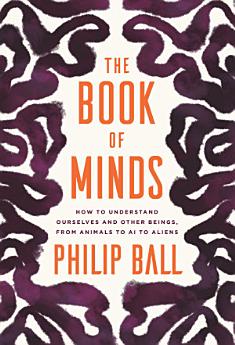
The Book of Minds: How to Understand Ourselves and Other Beings, from Animals to AI to Aliens
Jun 2022 · University of Chicago Press
Ebook
499
Pages
family_home
Eligible
info
About this ebook
This "fascinating and illuminating account" explores how we might perceive the mind if we didn't put humans at the center of our understanding ( The Guardian Observer).
Popular science writer Philip Ball explores a range of sciences to map our answers to a huge, philosophically rich question: How do we even begin to think about minds that are not human?
Taking a uniquely broad view of minds and where to find them—including in plants, aliens, and God—Philip Ball pulls the pieces together to explore what sorts of minds we might expect to find in the universe. In so doing, he offers for the first time a unified way of thinking about what minds are and what they can do, by locating them in what he calls the "space of possible minds."
By identifying and mapping out properties of mind without prioritizing the human, Ball sheds new light on a host of fascinating questions: What moral rights should we afford animals? Should we worry that AI is going to take over society? If there are intelligent aliens out there, how could we communicate with them? Should we?
Informed by conversations with leading researchers, Ball's brilliant survey of current views about the nature and existence of minds is more mind-expanding than we could imagine. In this fascinating panorama of other minds, we come to better know our own.
"Illuminates much of what makes human minds unique." — Publishers Weekly
"Comprehensive and far-ranging." — Library Journal
"A most thought-provoking book." — Psychology Today
This "fascinating and illuminating account" explores how we might perceive the mind if we didn't put humans at the center of our understanding ( The Guardian Observer).
Popular science writer Philip Ball explores a range of sciences to map our answers to a huge, philosophically rich question: Ho...
Discover more
About the author
Philip Ball is a freelance writer and broadcaster whose many books on the interactions of the sciences, the arts, and the wider culture include Bright Earth, Curiosity, Patterns in Nature, How to Grow a Human, The Modern Myths, and, most recently, The Elements, all also published by the University of Chicago Press. His book Critical Mass won the 2005 Aventis Prize for Science Books. Ball is also a presenter of Science Stories, the BBC Radio 4 series on the history of science. He trained as a chemist at the University of Oxford and as a physicist at the University of Bristol, and he was an editor at Nature for more than twenty years. He lives in London.
Philip Ball is a freelance writer and broadcaster whose many books on the interactions of the sciences, the arts, and the wider culture include Bright Earth, Curiosity, Patterns in Nature, How to Grow a Human, The Modern Myths, and, most recently, The Elements, all also published by the Universit...
Rate this ebook
Tell us what you think.
Reading information
Smartphones and tablets
Install the Google Play Books app for Android and iPad/iPhone. It syncs automatically with your account and allows you to read online or offline wherever you are.
Laptops and computers
You can listen to audiobooks purchased on Google Play using your computer's web browser.
eReaders and other devices
To read on e-ink devices like Kobo eReaders, you'll need to download a file and transfer it to your device. Follow the detailed Help Center instructions to transfer the files to supported eReaders.