About this ebook
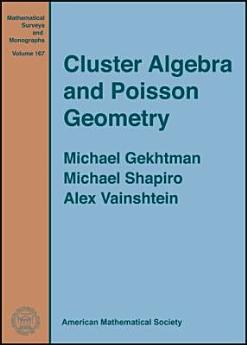
Cluster algebras, introduced by Fomin and Zelevinsky in 2001, are commutative rings with unit and no zero divisors equipped with a distinguished family of generators (cluster variables) grouped in overlapping subsets (clusters) of the same cardinality (the rank of the cluster algebra) connected by exchange relations. Examples of cluster algebras include coordinate rings of many algebraic varieties that play a prominent role in representation theory, invariant theory, the study of total positivity, etc. The theory of cluster algebras has witnessed a spectacular growth, first and foremost due to the many links to a wide range of subjects including representation theory, discrete dynamical systems, Teichmüller theory, and commutative and non-commutative algebraic geometry. This book is the first devoted to cluster algebras. After presenting the necessary introductory material about Poisson geometry and Schubert varieties in the first two chapters, the authors introduce cluster algebras and prove their main properties in Chapter 3. This chapter can be viewed as a primer on the theory of cluster algebras. In the remaining chapters, the emphasis is made on geometric aspects of the cluster algebra theory, in particular on its relations to Poisson geometry and to the theory of integrable systems. Cluster algebras, introduced by Fomin and Zelevinsky in 2001, are commutative rings with unit and no zero divisors equipped with a distinguished family of generators (cluster variables) grouped in overlapping subsets (clusters) of the same cardinality (the rank of the cluster algebra) connected by exchange relations. Examples of cluster algebras include coordinate rings of many algebraic varieties that play a prominent role in representation theory, invariant theory, the study of total positivity, etc. The theory of cluster algebras has witnessed a spectacular growth, first and foremost due to the many links to a wide range of subjects including representation theory, discrete dynamical systems, Teichmüller theory, and commutative and non-commutative algebraic geometry. This book is the first devoted to cluster algebras. After presenting the necessary introductory material about Poisson geometry and Schubert varieties in the first two chapters, the authors introduce cluster algebras and prove their main properties in Chapter 3. This chapter can be viewed as a primer on the theory of cluster algebras. In the remaining chapters, the emphasis is made on geometric aspects of the cluster algebra theory, in particular on its relations to Poisson geometry and to the theory of integrable systems.
Cluster algebras, introduced by Fomin and Zelevinsky in 2001, are commutative rings with unit and no zero divisors equipped with a distinguished family of generators (cluster variables) grouped in overlapping subsets (clusters) of the same cardinality (the rank of the cluster algebra) connected b...
Discover more
About the author
Michael J. Shapiro, professor of political science at the University of Hawai'i, is the author of numerous books, including Methods and Nations: Cultural Governance and the Indigenous Subject.
Michael J. Shapiro, professor of political science at the University of Hawai'i, is the author of numerous books, including Methods and Nations: Cultural Governance and the Indigenous Subject.
Rate this ebook
Tell us what you think.
Reading information
Smartphones and tablets
Install the Google Play Books app for Android and iPad/iPhone. It syncs automatically with your account and allows you to read online or offline wherever you are.
Laptops and computers
You can listen to audiobooks purchased on Google Play using your computer's web browser.
eReaders and other devices
To read on e-ink devices like Kobo eReaders, you'll need to download a file and transfer it to your device. Follow the detailed Help Center instructions to transfer the files to supported eReaders.