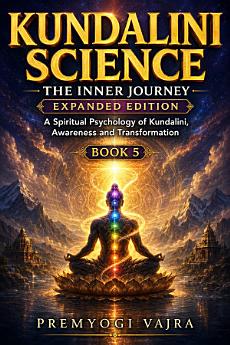
Kundalini Science: The Inner Journey — Expanded Edition: A Spiritual Psychology of Kundalini, Awareness and Transformation — Kundalini Science Series, Book 5
About this ebook
There comes a moment on the spiritual path when everything that can be said has almost been said, and yet the most essential crossing still remains.
Kundalini Science: The Inner Journey — Expanded Edition is the fifth and semi-final volume of the six-book Kundalini Science Series, standing at the decisive threshold between lived spiritual realization and the deeper silence toward which the journey gradually moves. It is the moment just before Kundalini itself becomes increasingly quiet.
Authored by Premyogi Vajra, a mystic yogi whose Kundalini awakened after one year of intense, continuous Kundalini Yoga meditation, this series is not theoretical speculation or merely a reinterpretation of scripture. It is a direct account of inner transformation, recorded through personal observation as the journey unfolded. The original chapters grew from personal blog writings corresponding to particular phases of awakening, self-realization, meditation, and sustained Savikalpa Samadhi.
What makes this work distinctive is its attempt to describe Kundalini with unusual clarity. The author began writing after recognizing that Kundalini had rarely been explained completely and plainly for the ordinary seeker. Much available literature appeared fragmented, heavily symbolic, or deliberately cryptic, making direct understanding difficult. Even traditional yogic descriptions of Samadhi can seem distant and abstract to the modern reader.
Kundalini Science therefore takes a deliberately direct approach. It explores the psychology, mechanics, experiences, and practical implications of Kundalini awakening through language intended to remain simple, transparent, experiential, and intuitive. The emphasis is not on creating mystery, but on making difficult inner experiences easier to examine.
This fifth volume brings the Kundalini phase of the journey toward its culmination. It explores Kundalini awakening, self-realization, Savikalpa Samadhi, Prana, chakras, Sushumna, breathlessness, Keval Kumbhak, Kundalini Yoga, Kriya, Tantra, Sankhya, Purusha and Prakriti, Sharirvigyan Darshan, non-duality, and the relationship between spiritual transformation and ordinary worldly life.
The book examines why awakening should not necessarily be regarded as the completion of the journey. Kundalini is viewed as a continuing transformative process whose deeper success may ultimately be seen not in the persistence of extraordinary experiences, but in what happens to fear, desire, emotional conditioning, mental noise, attachment, compassion, meditation, and everyday awareness.
The Expanded Author’s Edition preserves the original Book 5 as its foundation. It does not replace or rewrite the base edition. Instead, it adds later chapters and reflections that emerged through continued practice and observation after the original work was written.
These additions revisit the journey from a more mature perspective. They explore why some awakenings stabilize while others fade, why effort can gradually become effortless, why silence may become more attractive than bliss, why the ego can quietly survive even within spirituality, and why Kundalini awakening itself may eventually become less fascinating than the awareness it helped reveal.
The expanded material also develops the relationship between Purusha and Prakriti from a higher experiential perspective. Sankhya is not presented as something that must ultimately be rejected by non-duality. Instead, the distinction between Purusha and Prakriti becomes a practical way of understanding detachment, while non-duality takes the inquiry further toward the recognition that changing phenomena never stand outside the awareness in which they appear.
A particularly important part of this exploration is Sharirvigyan Darshan, through which the author examines the egoless functioning of the body's cells, emotional conditioning, witnessing, detachment, and the movement toward pure self-awareness. In this framework, spiritual understanding is not separated from the body or ordinary life. The body itself becomes a field through which philosophical insight can be observed and lived.
The book also explores the psychological transformation that may accompany prolonged practice: the gradual reduction of fear, desire and unnecessary mental activity; the emergence of compassion; the changing relationship with emotional reactions; and the possibility that ordinary consciousness can become increasingly extraordinary without appearing extraordinary from the outside.
The distinction between authentic Kundalini Yoga and sex-based occult Tantra practices is also examined with psychological and experiential clarity, without reducing the discussion to moral judgment or sensationalism. The emphasis remains on understanding, transformation, integration, and the direction of spiritual energy.
As the journey approaches Keval Kumbhak, the inquiry becomes increasingly subtle. Breath may slow or suspend, meditation can deepen, and the relationship between Kundalini, awareness and the body becomes increasingly difficult to describe through ordinary language. The movement then points toward the threshold of Nirvikalpa Samadhi, where even the need to describe experience begins to diminish.
This is why the book gradually shifts its emphasis:
from Kundalini to awareness,
from experience to transformation,
from transformation to detachment,
and from detachment toward silence.
The book also looks back across the development of the Kundalini Science project itself, showing how the understanding evolved through the six-volume journey—what became clearer, what remained unchanged, and how the inquiry gradually moved from energetic awakening toward awareness and silence.
This is therefore not simply another book about Kundalini awakening.
It is about what awakening becomes after the excitement of awakening itself begins to fade.
It asks whether spiritual maturity is really measured by increasingly extraordinary experiences—or by greater simplicity, stability, naturalness, freedom from psychological conditioning, compassion, and continuity of awareness in ordinary life.
The journey does not end with Kundalini.
It becomes quiet.
And that quietness opens the way to the concluding volume:
Kundalini Science – A Spiritual Psychology: Beyond Kundalini – The Journey to Nirvikalpa — Book 6
Book 5 is the threshold.
Book 6 begins where that threshold opens.
Discover more
Ratings and reviews
About the author
Premyogi Vajra is not a conventional teacher—he is a direct explorer of consciousness whose work arises from lived experience rather than formal scholarship or institutional teaching.
Author of more than 60 books in Hindi and English, his writing spans a wide spectrum of inquiry into spirituality, inner awareness, and human perception. Yet, his work is not rooted in abstract theory—it emerges from direct observation and practical exploration of consciousness itself.
His journey into inner transformation has been shaped by deep meditation, tantric understanding, and what he calls practical spiritual research—an approach that places experience above belief. Along this path, he has encountered profound states of awareness, including moments where the sense of individuality dissolves into a unified field of consciousness—states often described in yogic traditions as samadhi.
He has undergone two significant awakenings. The first unfolded spontaneously in a dream state during adolescence. The second arose through deliberate and systematic yogic practice in his forties. He has also reached states approaching keval kumbhak—the spontaneous suspension of breath—associated with nirvikalpa samadhi. Yet, he remains grounded in the understanding that such realization is not fully stabilized, and continues his practice with sincerity and dedication.
During his first awakening, he observed nonduality directly. Inspired by that experience, he intuitively developed Sharirvigyan Darshan as a practical framework to help maintain an awakened state while living in the world, to a greater or lesser extent. With this he got second awakening. After his second awakening, he similarly developed its equivalent and nondual Quantum Darshan through intuitive insight arising from that experience.
Rather than following rigid systems or borrowed doctrines, his path has been intuitive and experiential—focused on directly perceiving truth rather than adopting it from external authorities.
Beyond his inner explorations, Premyogi Vajra lives a balanced and grounded life. He has a deep interest in organic farming and animal welfare, reflecting his connection with nature and sustainable living. He enjoys meaningful cinema with his family, often combining it with travel and shared experiences.
His journeys are not merely recreational—they are driven by curiosity, observation, and a desire to understand life in its diverse expressions. In his quieter moments, he turns to music, playing the flute, harmonium, and guitar. Reading and writing remain his inborn passions.
Through his work, he does not seek followers, nor does he promote fixed doctrines. Instead, he extends an invitation—
to question, to explore, and to discover truth directly.
This book is one such invitation.