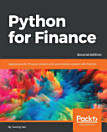
Python for Finance: If your interest is finance and trading, then using Python to build a financial calculator makes absolute sense. As does this book which is a hands-on guide covering everything from option theory to time series.
Apr 2014 · Packt Publishing Ltd
Ebook
408
Pages
Tools
info
About this ebook
Key Features
- Build a financial calculator based on Python
- Learn how to price various types of options such as European, American, average, lookback, and barrier options
- Write Python programs to download data from Yahoo! Finance
- Estimate returns and convert daily returns into monthly or annual returns
- Form an nstock portfolio and estimate its variancecovariance matrix
- Estimate VaR (Value at Risk) for a stock or portfolio
- Run CAPM (Capital Asset Pricing Model) and the FamaFrench 3factor model
- Learn how to optimize a portfolio and draw an efficient frontier
- Conduct various statistic tests such as Ttests, Ftests, and normality tests
Key Features
Book DescriptionA hands-on guide with easy-to-follow examples to help you learn about option theory, quantitative finance, financial modeling, and time series using Python. Python for Finance is perfect for graduate students, practitioners, and application developers who wish to lear...
Discover more
About the author
Yuxing Yan graduated from McGill university with a PhD in finance. He has taught various finance courses, such as Financial Modeling, Options and Futures, Portfolio Theory, Quantitative Financial Analysis, Corporate Finance, and Introduction to Financial Databases to undergraduate and graduate students at seven universities: two in Canada, one in Singapore, and four in the USA. Dr. Yan has actively done research with several publications in Journal of Accounting and Finance, Journal of Banking and Finance, Journal of Empirical Finance, Real Estate Review, Pacific Basin Finance Journal, Applied Financial Economics, and Annals of Operations Research. For example, his latest publication, co-authored with Shaojun Zhang, will appear in the Journal of Banking and Finance in 2014. His research areas include investment, market microstructure, and open source finance. He is proficient at several computer languages such as SAS, R, MATLAB, C, and Python. From 2003 to 2010, he worked as a technical director at Wharton Research Data Services (WRDS), where he debugged several hundred computer programs related to research for WRDS users. After that, he returned to teaching in 2010 and introduced R into several quantitative courses at two universities. Based on lecture notes, he has the first draft of an unpublished manuscript titled Financial Modeling using R. In addition, he is an expert on financial data. While teaching at NTU in Singapore, he offered a course called Introduction to Financial Databases to doctoral students. While working at WRDS, he answered numerous questions related to financial databases and helped update CRSP, Compustat, IBES, and TAQ (NYSE high-frequency database). In 2007, Dr. Yan and S.W. Zhu (his co-author) published a book titled Financial Databases, Shiwu Zhu and Yuxing Yan, Tsinghua University Press. Currently, he spends considerable time and effort on public financial data. If you have any queries, you can always contact him at yany@canisius.edu.
Yuxing Yan graduated from McGill university with a PhD in finance. He has taught various finance courses, such as Financial Modeling, Options and Futures, Portfolio Theory, Quantitative Financial Analysis, Corporate Finance, and Introduction to Financial Databases to undergraduate and graduate st...
Rate this ebook
Tell us what you think.
Reading information
Smartphones and tablets
Install the Google Play Books app for Android and iPad/iPhone. It syncs automatically with your account and allows you to read online or offline wherever you are.
Laptops and computers
You can listen to audiobooks purchased on Google Play using your computer's web browser.
eReaders and other devices
To read on e-ink devices like Kobo eReaders, you'll need to download a file and transfer it to your device. Follow the detailed Help Center instructions to transfer the files to supported eReaders.