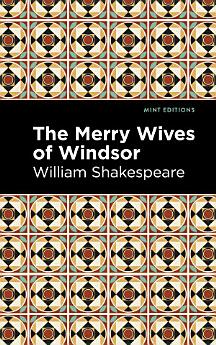
The Merry Wives of Windsor

· Graphic Arts Books
Ebook
130
Pages
Tools
Eligible

About this ebook

The Merry Wives of Windsor (1601) is a comedy by William Shakespeare. Following the success of Henry IV Part I, it is rumored that Queen Elizabeth requested that the bard write a play featuring the character Falstaff in love. Falstaff, a clownish character notable for his bravery and loyalty to King Henry V, remains one of Shakespeare’s most beloved characters. Despite this prominence, it has earned a reputation as one of the playwright’s least staged works. “Come, we have a hot venison pasty to dinner: come, gentlemen, I hope we shall drink down all unkindness.” For his wit and wordplay alone, William Shakespeare is often considered the greatest writer to ever work in the English language. Where he truly triumphs, however, is in his ability to portray complex human emotions, how these emotions contribute to relationships, and how these relationships interact with politics, culture, and religion. Arriving in Windsor with an empty stomach and even emptier pockets, Falstaff comes up with a plan to seduce a wealthy woman. When his servants refuse to deliver his letters to Mistresses Ford and Page—both of them married—he fires Pistol and Nym, who subsequently inform the ladies’ husbands. Eventually, the Mistresses get their hands on Falstaff’s letters and, upon discovering they are exactly the same, conspire to embarrass the aging, overweight bachelor. With a beautifully designed cover and professionally typeset manuscript, this edition of William Shakespeare’s The Merry Wives of Windsor is a classic of English literature reimagined for modern readers.
The Merry Wives of Windsor (1601) is a comedy by William Shakespeare. Following the success of Henry IV Part I, it is rumored that Queen Elizabeth requested that the bard write a play featuring the character Falstaff in love. Falstaff, a clownish character notable for his bravery and loyalty to K...

Discover more

About the author

William Shakespeare (1564-1616) was an English poet, playwright, and actor. Born in Stratford-upon-Avon, he was the son of John Shakespeare, an alderman and glove-maker, and Mary Arden, a woman from a wealthy family. Likely educated at the King’s New School, he would have studied Latin in his youth. At eighteen, he married Anne Hathaway, then twenty-six. Together, they raised three children—Susanna and twins Hamnet and Judith. By 1892, several of his early plays had appeared on stage in London. These works, including Richard III and Henry VI, show the influence of Elizabethan dramatists Thomas Kyd and Christopher Marlowe. He then found success with a series of comedies, such as A Midsummer Night’s Dream, The Merchant of Venice, As You Like It, and Twelfth Night. By the late 1590s, Shakespeare wrote two of his finest tragedies, Romeo and Juliet and Julius Caesar, proving his talent and thematic versatility. The beginning of the 17th century marked a turn in his work, ushering in an era often considered his darkest and most productive. Between 1600 and 1606, he produced such masterpieces as Hamlet, Othello, Macbeth, and King Lear, all of which are undoubtedly some of the finest works ever written in the English language. In addition to his 39 plays, many of which were performed by his own company at the legendary Globe Theatre, Shakespeare wrote 154 sonnets and three long poems, many of which continue to be read around the world.
William Shakespeare (1564-1616) was an English poet, playwright, and actor. Born in Stratford-upon-Avon, he was the son of John Shakespeare, an alderman and glove-maker, and Mary Arden, a woman from a wealthy family. Likely educated at the King’s New School, he would have studied Latin in his you...

Rate this ebook

Tell us what you think.

Reading information

Smartphones and tablets
Install the Google Play Books app for Android and iPad/iPhone. It syncs automatically with your account and allows you to read online or offline wherever you are.
Laptops and computers
You can listen to audiobooks purchased on Google Play using your computer's web browser.
eReaders and other devices
To read on e-ink devices like Kobo eReaders, you'll need to download a file and transfer it to your device. Follow the detailed Help Center instructions to transfer the files to supported eReaders.