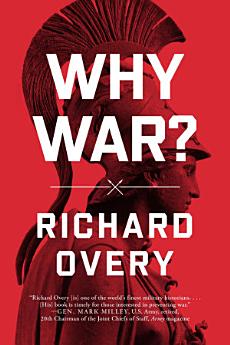
Why War?
Acerca de este libro electrónico
An Economist Best Book of the Year
“Richard Overy [is] one of the world’s finest military historians.… [His] book is timely for those interested in preventing war.” —Gen. Mark Milley, U.S. Army, retired, 20th Chairman of the Joint Chiefs of Staff, Army magazine
Richard Overy is not the first scholar to take up the title question. In 1931, at the request of the League of Nations, Albert Einstein asked Sigmund Freud to collaborate on a short work examining whether there was “a way of delivering mankind from the menace of war.” Published the next year as a pamphlet entitled Why War?, it conveyed Freud’s conclusion that the “death drive” made any deliverance impossible—the psychological impulse to destruction was universal in the animal kingdom. The global wars of the later 1930s and 1940s seemed ample evidence of the dismal conclusion.
A preeminent historian of those wars, Overy brings vast knowledge to the title question and years of experience unraveling the knotted motivations of war. His approach is to separate the major drivers and motivations, and consider the ways each has contributed to organized conflict. They range from the impulses embedded in human biology and psychology, to the incentives to conflict developed through cultural evolution, to competition for resources—conflicts stirred by the passions of belief, the effects of ecological stresses, the drive for power in leaders and nations, and the search for security. The discussions show remarkable range, delving deep into the Neolithic past, through the twentieth-century world wars, and up to the current conflict in Ukraine. The examples are absorbing, from the Roman Empire’s voracious appetite for resources to the impulse to power evident in Alexander the Great, Napoleon, and Hitler. The conclusion is not hopeful, but Overy’s book is a gift to readers: a compact, judicious, engrossing examination of a fundamental question.
Descubrir más
Acerca del autor
Richard Overy is the author of many outstanding histories of World War II, including Rain of Ruin: Tokyo, Hiroshima, and the Surrender of Japan. His study of Hitler and Stalin, The Dictators, won the Wolfson History Prize. He lives in England and Italy.