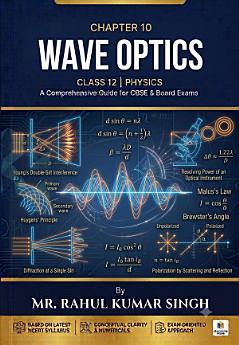
Wave Optics

· Class 12 Physics Master Series 第 10 冊 · Rahul kumar singh
電子書
58
頁數

關於這本電子書

While ray optics treats light as straight lines, Wave Optics (or physical optics) dives deeper, exploring phenomena that can only be explained by treating light as a wave. Historically championed by Christian Huygens and later solidified by Thomas Young and Augustin-Fresnel, this approach reveals that light bends, overlaps, and behaves just like ripples on water.

The foundation of this chapter rests on Huygens' Principle, which states that every point on a propagating wave disturbance, called a wavefront, acts as a source of secondary spherical wavelets. The forward envelope of these wavelets forms the new wavefront at any later instant.

This wave nature is beautifully demonstrated through three core phenomena:

Interference: Demonstrated by Young’s famous Double-Slit Experiment, where light waves from two coherent sources overlap to produce a pattern of alternating bright and dark bands (fringes) on a screen.

Diffraction: The slight bending of light waves around the sharp edges of an obstacle or aperture, allowing light to enter areas of geometrical shadow.

Polarization: The restriction of light's electric field vibrations to a single plane, proving definitively that light is a transverse wave.

These concepts are fundamental to understanding modern physics, laser technology, and the precise limitations of optical imaging systems.

While ray optics treats light as straight lines, Wave Optics (or physical optics) dives deeper, exploring phenomena that can only be explained by treating light as a wave. Historically championed by Christian Huygens and later solidified by Thomas Young and Augustin-Fresnel, this approach reveals...

探索更多

為這本電子書評分

請分享你的寶貴意見。

閱讀資訊

智能手機和平板電腦
請安裝 Android 版和 iPad/iPhone 版「Google Play 圖書」應用程式。這個應用程式會自動與你的帳戶保持同步,讓你隨時隨地上網或離線閱讀。
手提電腦和電腦
你可以使用電腦的網絡瀏覽器聆聽在 Google Play 上購買的有聲書。
電子書閱讀器及其他裝置
如要在 Kobo 等電子墨水裝置上閱覽書籍,你需要下載檔案並傳輸到你的裝置。請按照說明中心的詳細指示,將檔案傳輸到支援的電子書閱讀器。