Wave Optics

· Class 12 Physics Master Series 第 10 本图书 · Rahul kumar singh
电子书
58
页

关于此电子书

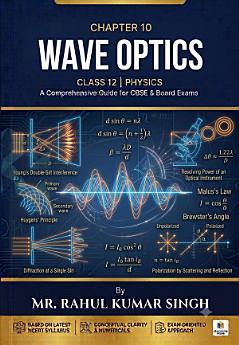
While ray optics treats light as straight lines, Wave Optics (or physical optics) dives deeper, exploring phenomena that can only be explained by treating light as a wave. Historically championed by Christian Huygens and later solidified by Thomas Young and Augustin-Fresnel, this approach reveals that light bends, overlaps, and behaves just like ripples on water.

The foundation of this chapter rests on Huygens' Principle, which states that every point on a propagating wave disturbance, called a wavefront, acts as a source of secondary spherical wavelets. The forward envelope of these wavelets forms the new wavefront at any later instant.

This wave nature is beautifully demonstrated through three core phenomena:

Interference: Demonstrated by Young’s famous Double-Slit Experiment, where light waves from two coherent sources overlap to produce a pattern of alternating bright and dark bands (fringes) on a screen.

Diffraction: The slight bending of light waves around the sharp edges of an obstacle or aperture, allowing light to enter areas of geometrical shadow.

Polarization: The restriction of light's electric field vibrations to a single plane, proving definitively that light is a transverse wave.

These concepts are fundamental to understanding modern physics, laser technology, and the precise limitations of optical imaging systems.

While ray optics treats light as straight lines, Wave Optics (or physical optics) dives deeper, exploring phenomena that can only be explained by treating light as a wave. Historically championed by Christian Huygens and later solidified by Thomas Young and Augustin-Fresnel, this approach reveals...

探索更多

为此电子书评分

欢迎向我们提供反馈意见。

如何阅读

智能手机和平板电脑
只要安装 Android 和 iPad/iPhone 版的 Google Play 图书应用,不仅应用内容会自动与您的账号同步,还能让您随时随地在线或离线阅览图书。
笔记本电脑和台式机
您可以使用计算机的网络浏览器聆听您在 Google Play 购买的有声读物。
电子阅读器和其他设备
如果要在 Kobo 电子阅读器等电子墨水屏设备上阅读,您需要下载一个文件,并将其传输到相应设备上。若要将文件传输到受支持的电子阅读器上,请按帮助中心内的详细说明操作。