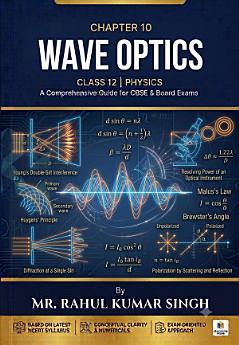
Wave Optics

· Class 12 Physics Master Series ספר 10 · Rahul kumar singh
ספר דיגיטלי
58
דפים

מידע על הספר הדיגיטלי הזה

While ray optics treats light as straight lines, Wave Optics (or physical optics) dives deeper, exploring phenomena that can only be explained by treating light as a wave. Historically championed by Christian Huygens and later solidified by Thomas Young and Augustin-Fresnel, this approach reveals that light bends, overlaps, and behaves just like ripples on water.

The foundation of this chapter rests on Huygens' Principle, which states that every point on a propagating wave disturbance, called a wavefront, acts as a source of secondary spherical wavelets. The forward envelope of these wavelets forms the new wavefront at any later instant.

This wave nature is beautifully demonstrated through three core phenomena:

Interference: Demonstrated by Young’s famous Double-Slit Experiment, where light waves from two coherent sources overlap to produce a pattern of alternating bright and dark bands (fringes) on a screen.

Diffraction: The slight bending of light waves around the sharp edges of an obstacle or aperture, allowing light to enter areas of geometrical shadow.

Polarization: The restriction of light's electric field vibrations to a single plane, proving definitively that light is a transverse wave.

These concepts are fundamental to understanding modern physics, laser technology, and the precise limitations of optical imaging systems.

While ray optics treats light as straight lines, Wave Optics (or physical optics) dives deeper, exploring phenomena that can only be explained by treating light as a wave. Historically championed by Christian Huygens and later solidified by Thomas Young and Augustin-Fresnel, this approach reveals...

עוד ספרים

רוצה לדרג את הספר הדיגיטלי הזה?

נשמח לשמוע מה דעתך.

איך קוראים את הספר

סמארטפונים וטאבלטים
כל מה שצריך לעשות הוא להתקין את האפליקציה של Google Play Books ל-Android או ל-iPad/iPhone‏. היא מסתנכרנת באופן אוטומטי עם החשבון שלך ומאפשרת לך לקרוא מכל מקום, גם ללא חיבור לאינטרנט.
מחשבים ניידים ושולחניים
ניתן להאזין לספרי אודיו שנרכשו ב-Google Play באמצעות דפדפן האינטרנט של המחשב.
eReaders ומכשירים אחרים
כדי לקרוא במכשירים עם תצוגת דיו אלקטרוני (e-ink) כמו הקוראים האלקטרוניים של Kobo, צריך להוריד קובץ ולהעביר אותו למכשיר. יש לפעול לפי ההוראות המפורטות במרכז העזרה כדי להעביר את הקבצים לקוראים אלקטרוניים נתמכים.