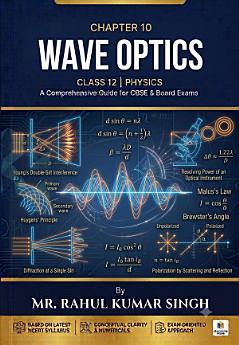
Wave Optics

· Class 12 Physics Master Series Livre 10 · Rahul kumar singh
E-book
58
Pages

À propos de cet e-book

While ray optics treats light as straight lines, Wave Optics (or physical optics) dives deeper, exploring phenomena that can only be explained by treating light as a wave. Historically championed by Christian Huygens and later solidified by Thomas Young and Augustin-Fresnel, this approach reveals that light bends, overlaps, and behaves just like ripples on water.

The foundation of this chapter rests on Huygens' Principle, which states that every point on a propagating wave disturbance, called a wavefront, acts as a source of secondary spherical wavelets. The forward envelope of these wavelets forms the new wavefront at any later instant.

This wave nature is beautifully demonstrated through three core phenomena:

Interference: Demonstrated by Young’s famous Double-Slit Experiment, where light waves from two coherent sources overlap to produce a pattern of alternating bright and dark bands (fringes) on a screen.

Diffraction: The slight bending of light waves around the sharp edges of an obstacle or aperture, allowing light to enter areas of geometrical shadow.

Polarization: The restriction of light's electric field vibrations to a single plane, proving definitively that light is a transverse wave.

These concepts are fundamental to understanding modern physics, laser technology, and the precise limitations of optical imaging systems.

While ray optics treats light as straight lines, Wave Optics (or physical optics) dives deeper, exploring phenomena that can only be explained by treating light as a wave. Historically championed by Christian Huygens and later solidified by Thomas Young and Augustin-Fresnel, this approach reveals...

En voir d'autres

Donner une note à cet e-book

Dites-nous ce que vous en pensez.

Informations sur la lecture

Smartphones et tablettes
Installez l'application Google Play Livres pour Android et iPad ou iPhone. Elle se synchronise automatiquement avec votre compte et vous permet de lire des livres en ligne ou hors connexion, où que vous soyez.
Ordinateurs portables et de bureau
Vous pouvez écouter les livres audio achetés sur Google Play à l'aide du navigateur Web de votre ordinateur.
Liseuses et autres appareils
Pour lire sur des appareils e-Ink, comme les liseuses Kobo, vous devez télécharger un fichier et le transférer sur l'appareil en question. Suivez les instructions détaillées du Centre d'aide pour transférer les fichiers sur les liseuses compatibles.