Всичко за тази електронна книга
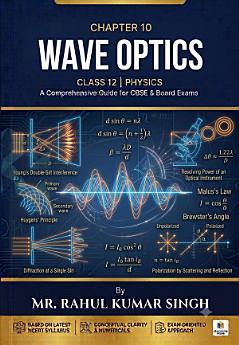
The foundation of this chapter rests on Huygens' Principle, which states that every point on a propagating wave disturbance, called a wavefront, acts as a source of secondary spherical wavelets. The forward envelope of these wavelets forms the new wavefront at any later instant.
This wave nature is beautifully demonstrated through three core phenomena:
Interference: Demonstrated by Young’s famous Double-Slit Experiment, where light waves from two coherent sources overlap to produce a pattern of alternating bright and dark bands (fringes) on a screen.
Diffraction: The slight bending of light waves around the sharp edges of an obstacle or aperture, allowing light to enter areas of geometrical shadow.
Polarization: The restriction of light's electric field vibrations to a single plane, proving definitively that light is a transverse wave.
These concepts are fundamental to understanding modern physics, laser technology, and the precise limitations of optical imaging systems.


