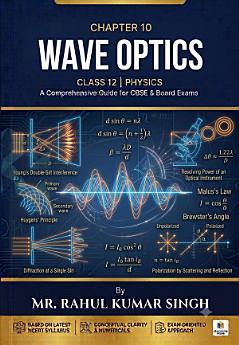
Wave Optics

· Class 12 Physics Master Series Кніга 10 · Rahul kumar singh
Электронная кніга
58
Старонкі

Пра гэту электронную кнігу

While ray optics treats light as straight lines, Wave Optics (or physical optics) dives deeper, exploring phenomena that can only be explained by treating light as a wave. Historically championed by Christian Huygens and later solidified by Thomas Young and Augustin-Fresnel, this approach reveals that light bends, overlaps, and behaves just like ripples on water.

The foundation of this chapter rests on Huygens' Principle, which states that every point on a propagating wave disturbance, called a wavefront, acts as a source of secondary spherical wavelets. The forward envelope of these wavelets forms the new wavefront at any later instant.

This wave nature is beautifully demonstrated through three core phenomena:

Interference: Demonstrated by Young’s famous Double-Slit Experiment, where light waves from two coherent sources overlap to produce a pattern of alternating bright and dark bands (fringes) on a screen.

Diffraction: The slight bending of light waves around the sharp edges of an obstacle or aperture, allowing light to enter areas of geometrical shadow.

Polarization: The restriction of light's electric field vibrations to a single plane, proving definitively that light is a transverse wave.

These concepts are fundamental to understanding modern physics, laser technology, and the precise limitations of optical imaging systems.

While ray optics treats light as straight lines, Wave Optics (or physical optics) dives deeper, exploring phenomena that can only be explained by treating light as a wave. Historically championed by Christian Huygens and later solidified by Thomas Young and Augustin-Fresnel, this approach reveals...

Знайдзіце больш

Ацаніце гэту электронную кнігу

Падзяліцеся сваімі меркаваннямі.

Чытанне інфармацыb

Смартфоны і планшэты
Усталюйце праграму "Кнігі Google Play" для Android і iPad/iPhone. Яна аўтаматычна сінхранізуецца з вашым уліковым запісам і дазваляе чытаць у інтэрнэце або па-за сеткай, дзе б вы ні былі.
Ноўтбукі і камп’ютары
У вэб-браўзеры камп’ютара можна слухаць аўдыякнігі, купленыя ў Google Play.
Электронныя кнiгi i iншыя прылады
Каб чытаць на такіх прыладах для электронных кніг, як, напрыклад, Kobo, трэба спампаваць файл і перанесці яго на сваю прыладу. Выканайце падрабязныя інструкцыі, прыведзеныя ў Даведачным цэнтры, каб перанесці файлы на прылады, якія падтрымліваюцца.