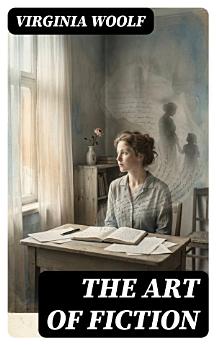
The Art of Fiction: Enriched edition. Modernist Reflections on Narrative Structure, Character, and the Craft of Storytelling
Nov 2022 · DigiCat
Ebook
284
Pages
family_home
Eligible
info
About this ebook
In "The Art of Fiction," Virginia Woolf presents a profound exploration of the intricacies and nuances within the craft of writing. In this seminal essay, Woolf reflects on the evolution of fiction, assessing its potential to express the complexity of human experience. Employing a strikingly modernist style, she delves into the interplay of character, narrative structure, and the psychological underpinnings that shape literary creation. Woolf's observations draw from the broader tapestry of early 20th-century literature, positioning her ideas within the context of a rapidly changing social and artistic landscape, influenced by contemporaries such as James Joyce and Marcel Proust. Virginia Woolf, a central figure in the modernist movement, utilized her keen insights into human consciousness and social dynamics, galvanized by her own experiences as a writer and member of the Bloomsbury Group. Her deep conviction that fiction should reflect the totality of human experience is evident in her thoughtful criticism and exploration of literary form. Woolf's personal struggles with mental health and her quest for authentic expression significantly informed her literary philosophy, bringing a rare depth to her interpretations. "The Art of Fiction" stands as an essential read for both aspiring writers and ardent readers, offering timeless wisdom about the writer's craft. Woolf's eloquent articulation of the artistic process encourages readers to reconsider the boundaries of fiction and the role of the author in constructing meaning. This work is not merely an essay on writing; it is an invitation to engage with the very nature of storytelling itself. In this enriched edition, we have carefully created added value for your reading experience: - A comprehensive Introduction outlines these selected works' unifying features, themes, or stylistic evolutions. - The Author Biography highlights personal milestones and literary influences that shape the entire body of writing. - A Historical Context section situates the works in their broader era—social currents, cultural trends, and key events that underpin their creation. - A concise Synopsis (Selection) offers an accessible overview of the included texts, helping readers navigate plotlines and main ideas without revealing critical twists. - A unified Analysis examines recurring motifs and stylistic hallmarks across the collection, tying the stories together while spotlighting the different work's strengths. - Reflection questions inspire deeper contemplation of the author's overarching message, inviting readers to draw connections among different texts and relate them to modern contexts. - Lastly, our hand‐picked Memorable Quotes distill pivotal lines and turning points, serving as touchstones for the collection's central themes.
In "The Art of Fiction," Virginia Woolf presents a profound exploration of the intricacies and nuances within the craft of writing. In this seminal essay, Woolf reflects on the evolution of fiction, assessing its potential to express the complexity of human experience. Employing a strikingly mode...
About the author
Virginia Woolf (1882–1941) was an English writer, regarded as one of the foremost modernist literary figures of the twentieth century. Known for her innovative narrative techniques and lyrical prose, Woolf was a central figure in the Bloomsbury Group, an assemblage of English writers, intellectuals, philosophers, and artists. Although 'The Art of Fiction' is not a title directly attributed to Woolf, her works such as 'Mrs. Dalloway' (1925), 'To the Lighthouse' (1927), and 'Orlando' (1928) exemplify her profound engagement with the craft of fiction. Woolf's essays, collected in 'The Common Reader' (1925), further showcase her literary criticism and reflections on the art of writing. Her stream-of-consciousness technique redefined narrative structures, delving deep into the consciousness of her characters. Woolf was also an astute critic and a feminist thinker, profoundly explored in her expanded essay 'A Room of One's Own' (1929), where she argues for both a literal and figurative space for women writers within a literary tradition dominated by men. Woolf's legacy endures; her works continue to be studied and celebrated for their stylistic innovation, depth of psychological insight, and exploration of the human condition.
Virginia Woolf (1882–1941) was an English writer, regarded as one of the foremost modernist literary figures of the twentieth century. Known for her innovative narrative techniques and lyrical prose, Woolf was a central figure in the Bloomsbury Group, an assemblage of English writers, intellectua...
Rate this ebook
Tell us what you think.
Reading information
Smartphones and tablets
Install the Google Play Books app for Android and iPad/iPhone. It syncs automatically with your account and allows you to read online or offline wherever you are.
Laptops and computers
You can listen to audiobooks purchased on Google Play using your computer's web browser.
eReaders and other devices
To read on e-ink devices like Kobo eReaders, you'll need to download a file and transfer it to your device. Follow the detailed Help Center instructions to transfer the files to supported eReaders.