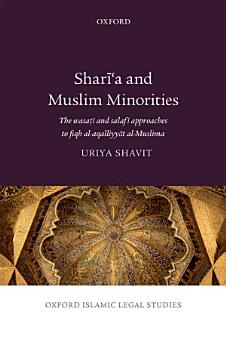
Shari'a and Muslim Minorities: The wasati and salafi approaches to fiqh al-aqalliyyat al-Muslima
Nov 2015 · Oxford University Press
star
1 review
Ebook
240
Pages
Tools
info
family_home
Eligible
info
About this ebook
Based on a comparative analysis of several hundred religio-juristic treatises and fatwas (religious decisions), Shari'a and Muslim Minorities: The Wasati and Salafi Approaches to Fiqh al-Aqalliyyat al-Muslima offers the most systematic and comprehensive study to date of fiqh al aqalliyyat al-Muslima - the field in Islamic jurisprudence that treats issues that are unique to Muslims living in majority non-Muslim societies. The book argues that two main contesting approaches to fiqh al-aqalliyyat al-Muslima, the wasati and the salafi, have developed, in part dialectically. While both envision a future Islamizing of the West as a main justification for Muslim residence in the West, the wasati approach is pragmatic, facilitating, and integration-minded, whereas the salafi calls for strict application of religious norms and for introversion. The volume examines diverse and highly-debated juristic issues, including the permissibility of naturalizing in non-Muslim states, participating in their electoral systems and serving in their militaries and police forces; the permissibility of taking mortgages and student loans; the permissibility of congratulating Christians on Christmas or receiving Christmas bonuses; and the permissibility of working in professions that involve breaching of religio-legal prohibitions (e.g. serving pork). Discussions highlight the diversity within contemporary Islamic jurisprudence and introduce new nuances to highly-charged concepts such as proselytizing, integration, and multiculturalism.
Based on a comparative analysis of several hundred religio-juristic treatises and fatwas (religious decisions), Shari'a and Muslim Minorities: The Wasati and Salafi Approaches to Fiqh al-Aqalliyyat al-Muslima offers the most systematic and comprehensive study to date of fiqh al aqalliyyat al-Musl...
Discover more
Ratings and reviews
1 review

TheFirmMountains
- Flag inappropriate
- Show review history
April 27, 2024
The author is clearly coming with an agenda and lying against the religion of Islam which when practised purely according to authentic texts and official scholarly verdicts crossing back centuries to the earliest generation of Muslims, we find that the agenda unravels and becomes clear and is contradictory to the earliest examples of Islam practised. Islam gives respect and tolerance of other faiths but never compromising on the clear tenets of Islam such as described in this book. The author did not take great care in actualising Islam's laws and regulations when interacting with non-Muslims, their traditions and the regulations derived from the shariah which have not changed since the 1st century. The author seems to view that a Muslim cannot exist in a non-Muslim land until they integrate by leaving off clear regulations of Islam, and that holding on to such, is infact "unislamic" and rather the "correct" Islam in her/their view is one which is transformative/fluid. False
About the author
Uriya Shavit is an Associate Professor at the Department for Arabic and Islamic Studies and the Program in Religious Studies at Tel Aviv University. He specializes in the study of Arab discourses on democracy and science, Islamist ideology and Islamic law, and has published seven books and twenty-five articles in these fields.
Uriya Shavit is an Associate Professor at the Department for Arabic and Islamic Studies and the Program in Religious Studies at Tel Aviv University. He specializes in the study of Arab discourses on democracy and science, Islamist ideology and Islamic law, and has published seven books and twenty...
Rate this ebook
Tell us what you think.
Reading information
Smartphones and tablets
Install the Google Play Books app for Android and iPad/iPhone. It syncs automatically with your account and allows you to read online or offline wherever you are.
Laptops and computers
You can listen to audiobooks purchased on Google Play using your computer's web browser.
eReaders and other devices
To read on e-ink devices like Kobo eReaders, you'll need to download a file and transfer it to your device. Follow the detailed Help Center instructions to transfer the files to supported eReaders.