About this ebook
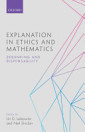
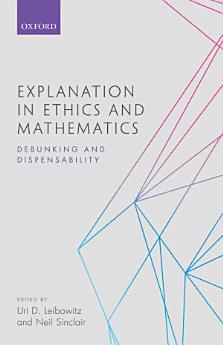
How far should our realism extend? For many years philosophers of mathematics and philosophers of ethics have worked independently to address the question of how best to understand the entities apparently referred to by mathematical and ethical talk. But the similarities between their endeavours are not often emphasised. This book provides that emphasis. In particular, it focuses on two types of argumentative strategies that have been deployed in both areas. The first--debunking arguments--aims to put pressure on realism by emphasising the seeming redundancy of mathematical or moral entities when it comes to explaining our judgements. In the moral realm this challenge has been made by Gilbert Harman and Sharon Street; in the mathematical realm it is known as the 'Benacerraf-Field' problem. The second strategy--indispensability arguments--aims to provide support for realism by emphasising the seeming intellectual indispensability of mathematical or moral entities, for example when constructing good explanatory theories. This strategy is associated with Quine and Putnam in mathematics and with Nicholas Sturgeon and David Enoch in ethics. Explanation in Ethics and Mathematics addresses these issues through an explicitly comparative methodology which we call the 'companions in illumination' approach. By considering how argumentative strategies in the philosophy of mathematics might apply to the philosophy of ethics, and vice versa, the papers collected here break new ground in both areas. For good measure, two further companions for illumination are also broached: the philosophy of chance and the philosophy of religion. Collectively, these comparisons light up new questions, arguments, and problems of interest to scholars interested in realism in any area.
How far should our realism extend? For many years philosophers of mathematics and philosophers of ethics have worked independently to address the question of how best to understand the entities apparently referred to by mathematical and ethical talk. But the similarities between their endeavours ...
Discover more
About the author
Uri D. Leibowitz studied Physics and Philosophy at Tel-Aviv University in Israel. He earned his PhD from the University of Massachusetts, Amherst. Before joining Nottingham's Department of Philosophy he had taught at the University of Colorado at Boulder and Cornell College. He has published papers in Noûs, Philosophical Studies, The Journal of Moral Philosophy,and Ethical Theory and Moral Practice. His work covers issues in metaethics and normative ethics, the philosophy of science, and ancient philosophy. He has been awarded an AHRC-funded research project on explanation in ethics. Neil Sinclair studied philosophy at both Cambridge and Oxford before joining the Philosophy Department at the University of Nottingham. His principal research area is metaethics. He has published papers in Philosophical Studies, The Philosophical Quarterly, Analysis, and Biology and Philosophy. His work covers issues such as the nature of truth, belief and moral mental content, the evolutionary origins of moral judgement, the logic of moral arguments, moral mind-independence, and the nature of moral explanations. He has been awarded two AHRC-funded research projects: one on moral mental content, and one on explanation in ethics. In 2014 he received a University of Nottingham Lord Dearing Award for outstanding contribution to the development of teaching and learning.
Uri D. Leibowitz studied Physics and Philosophy at Tel-Aviv University in Israel. He earned his PhD from the University of Massachusetts, Amherst. Before joining Nottingham's Department of Philosophy he had taught at the University of Colorado at Boulder and Cornell College. He has published pape...
Rate this ebook
Tell us what you think.
Reading information
Smartphones and tablets
Install the Google Play Books app for Android and iPad/iPhone. It syncs automatically with your account and allows you to read online or offline wherever you are.
Laptops and computers
You can listen to audiobooks purchased on Google Play using your computer's web browser.
eReaders and other devices
To read on e-ink devices like Kobo eReaders, you'll need to download a file and transfer it to your device. Follow the detailed Help Center instructions to transfer the files to supported eReaders.