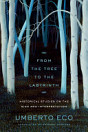
From the Tree to the Labyrinth: Historical Studies on the Sign and Interpretation
Feb 2014 · Harvard University Press
Ebook
590
Pages
About this ebook
The way we create and organize knowledge is the theme of From the Tree to the Labyrinth, a major achievement by one of the world’s foremost thinkers on language and interpretation. Umberto Eco begins by arguing that our familiar system of classification by genus and species derives from the Neo-Platonist idea of a “tree of knowledge.” He then moves to the idea of the dictionary, which—like a tree whose trunk anchors a great hierarchy of branching categories—orders knowledge into a matrix of definitions. In Eco’s view, though, the dictionary is too rigid: it turns knowledge into a closed system. A more flexible organizational scheme is the encyclopedia, which—instead of resembling a tree with finite branches—offers a labyrinth of never-ending pathways. Presenting knowledge as a network of interlinked relationships, the encyclopedia sacrifices humankind’s dream of possessing absolute knowledge, but in compensation we gain the freedom to pursue an infinity of new connections and meanings.
Moving effortlessly from analyses of Aristotle and James Joyce to the philosophical difficulties of telling dogs from cats, Eco demonstrates time and again his inimitable ability to bridge ancient, medieval, and modern modes of thought. From the Tree to the Labyrinth is a brilliant illustration of Eco’s longstanding argument that problems of interpretation can be solved only in historical context.
Moving effortlessly from analyses of Aristotle and James Joyce to the philosophical difficulties of telling dogs from cats, Eco demonstrates time and again his inimitable ability to bridge ancient, medieval, and modern modes of thought. From the Tree to the Labyrinth is a brilliant illustration of Eco’s longstanding argument that problems of interpretation can be solved only in historical context.
The way we create and organize knowledge is the theme of From the Tree to the Labyrinth, a major achievement by one of the world’s foremost thinkers on language and interpretation. Umberto Eco begins by arguing that our familiar system of classification by genus and species derives from the Neo-P...
About the author
Umberto Eco (1932–2016) was an acclaimed writer, philosopher, medievalist, and semiotician. In addition to dozens of nonfiction books, he authored seven novels, including The Name of the Rose, which has been translated into more than forty languages and has sold more than fifty million copies worldwide.
Umberto Eco (1932–2016) was an acclaimed writer, philosopher, medievalist, and semiotician. In addition to dozens of nonfiction books, he authored seven novels, including The Name of the Rose, which has been translated into more than forty languages and has sold more than fifty million copies wor...
Rate this ebook
Tell us what you think.
Reading information
Smartphones and tablets
Install the Google Play Books app for Android and iPad/iPhone. It syncs automatically with your account and allows you to read online or offline wherever you are.
Laptops and computers
You can listen to audiobooks purchased on Google Play using your computer's web browser.
eReaders and other devices
To read on e-ink devices like Kobo eReaders, you'll need to download a file and transfer it to your device. Follow the detailed Help Center instructions to transfer the files to supported eReaders.