About this ebook
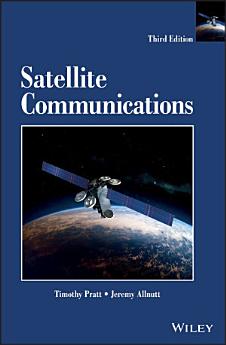
There have been many changes in the thirty three years since the first edition of Satellite Communications was published. There has been a complete transition from analog to digital communication systems, withanalog techniques replaced by digital modulation and digital signal processing. While distribution of television programming remains the largest sector of commercial satellite communications, low earth orbit constellations of satellites for Internet access are set to challenge that dominance.
In the third edition, chapters one through three cover topics that are specific to satellites, including orbits, launchers, and spacecraft. Chapters four through seven cover the principles of digital communication systems, radio frequency communications, digital modulation and multiple access techniques, and propagation in the earth’s atmosphere, topics that are common to all radio communication systems. Chapters eight through twelve cover applications that include non-geostationary satellite systems, low throughput systems, direct broadcast satellite television, Internet access by satellite, and global navigation satellite systems. The chapter on Internet access by satellite is new to the third edition, and each of the chapters has been extensively revised to include the many changes in the field since the publication of the second edition in 2003. Two appendices have been added that cover digital transmission of analog signals, and antennas.
An invaluable resource for students and professionals alike, this book:
- Focuses on the fundamental theory of satellite communications
- Explains the underlying principles and essential mathematics required to understand the physics and engineering of satellite communications
- Discusses the expansion of satellite communication systems in areas such as direct-broadcast satellite TV, GPS, and internet access
- Introduces the rapidly advancing field of small satellites, referred to as SmallSats or CubeSats
- Provides relevant practice problems based on real-world satellite systems
Satellite Communications is required reading for undergraduate and postgraduate students in satellite communications courses and an authoritative reference for engineers working in communications, systems and networks, and satellite operations and management.
Discover more
Ratings and reviews
About the author
Timothy Pratt is Emeritus Professor of Electrical and Computer Engineering at Virginia Tech, USA. He is a life senior member of the Institute of Electrical and Electronic Engineering. After industrial experience in UK industry, he taught at the University of Birmingham for ten years and at Virginia Tech for thirty years. He retired from Virginia Tech in 2013 and lives on a farm in Blacksburg, Virginia.
Jeremy Allnutt is Emeritus Professor of Electrical and Computer Engineering at George Mason University, USA. He was a telecommunications research scientist in England and Canada and then Intelsat in Washington, DC, USA. After Intelsat, he spent four years as a professor in ECE at the Northern Virginia campus of Virginia Tech before joining George Mason University, from which he retired in 2014. He is a fellow of the Institute of Electrical and Electronic Engineering and a fellow of the Institution of Engineering and Technology (UK).