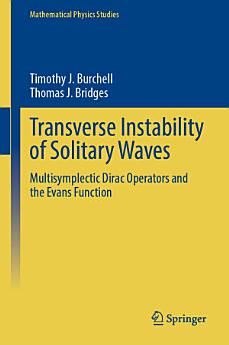
Transverse Instability of Solitary Waves: Multisymplectic Dirac Operators and the Evans Function

·
· Springer Nature
Ebook
164
Pages

About this ebook

This book presents a wide-ranging geometric approach to the stability of solitary wave solutions of Hamiltonian partial differential equations (PDEs). It blends original research with background material and a review of the literature. The overarching aim is to integrate geometry, algebra, and analysis into a theoretical framework for the spectral problem associated with the transverse instability of line solitary wave solutions—waves that travel uniformly in a horizontal plane and are embedded in two spatial dimensions. Rather than focusing on individual PDEs, the book develops an abstract class of Hamiltonian PDEs in two spatial dimensions and time, based on multisymplectic Dirac operators and their generalizations. This class models a broad range of nonlinear wave equations and benefits from a distinct symplectic structure associated with each spatial dimension and time. These structures inform both the existence theory (via variational principles, the Maslov index, and transversality conditions) and the linear stability analysis (through a multisymplectic partition of the Evans function). The spectral problem arising from linearization about a solitary wave is formulated as a dynamical system, with three symplectic structures contributing to the analysis. A two-parameter Evans function—depending on the spectral parameter and transverse wavenumber—is constructed from this system. This structure enables new results concerning the Evans function and the linear transverse instability of solitary waves. A key result is an abstract derivative formula for the Evans function in the regime of small stability exponents and transverse wavenumbers. To illustrate the theory, the book introduces a class of vector-valued nonlinear wave equations in 2+1 dimensions that are multisymplectic and admit explicit solitary wave solutions. In this example, the stable and unstable subspaces involved in the Evans function construction are each four-dimensional and can be explicitly computed. The example is used to demonstrate the geometric instability condition and to explore the inner workings of the theory in detail.
This book presents a wide-ranging geometric approach to the stability of solitary wave solutions of Hamiltonian partial differential equations (PDEs). It blends original research with background material and a review of the literature. The overarching aim is to integrate geometry, algebra, and an...

Discover more

About the author

Thomas Bridges is a Professor of Mathematics at the University of Surrey. He has been researching the theory of nonlinear waves for over 30 years. In addition to a PhD from Penn State, he has held fellowships in 5 countries: NSF Postdoctoral Fellowship (Wisconsin), Fellowship at Queen’s College (Oxford), NWO Fellowship (Utrecht), Humboldt Fellowship (Stuttgart), and CNRS Fellowship (ENS Cachan). TJB has over 170 publications, has authored one book and co-authored two other books. He has contributed across the pure to applied spectrum in the context of nonlinear waves, geometric numerics, Hamiltonian systems, multisymplectic geometry, and Whitham modulation theory.

Timothy Burchell as a Visiting Postdoctoral Researcher in Mathematics at the University of Surrey. He received his PhD in 2022 from Surrey, in the area of nonlinear waves, stability, and Clifford analysis. His undergraduate degree was also from Surrey, and he was awarded the Ron Shail Prize for finishing top of his class. His research is currently focused on new directions in the geometry, structure and dynamics of nonlinear waves.
Thomas Bridges is a Professor of Mathematics at the University of Surrey. He has been researching the theory of nonlinear waves for over 30 years. In addition to a PhD from Penn State, he has held fellowships in 5 countries: NSF Postdoctoral Fellowship (Wisconsin), Fellowship at Queen’s College (...

Rate this ebook

Tell us what you think.

Reading information

Smartphones and tablets
Install the Google Play Books app for Android and iPad/iPhone. It syncs automatically with your account and allows you to read online or offline wherever you are.
Laptops and computers
You can listen to audiobooks purchased on Google Play using your computer's web browser.
eReaders and other devices
To read on e-ink devices like Kobo eReaders, you'll need to download a file and transfer it to your device. Follow the detailed Help Center instructions to transfer the files to supported eReaders.