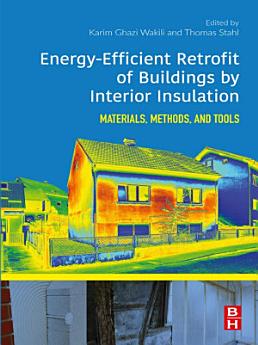
Energy-Efficient Retrofit of Buildings by Interior Insulation: Materials, Methods, and Tools

·
· Woodhead Publishing
Ebook
518
Pages
Eligible

About this ebook

Energy-Efficient Retrofit of Buildings by Interior Insulation: Materials, Methods and Tools offers readers comprehensive coverage of current research in German Language Countries. Chapters provide an overview on the development of energy efficiency for building retrofits and the role of internal insulation, cover materials with chapters on Brick, Wood, Plaster, Clay, and Natural Stone, explain the impact of internal insulation in those materials and how to cope with problems such as moisture build, mold and algae growth, provide practical advice on how to apply internal insulation in the most effective way, including Salt Efflorescence, Noise Protection, Fire Prevention, and more. The practical approach of the book, with examples in all chapters, makes it valuable for Civil and Architectural Engineers involved with building retrofit. The book may also be useful to researchers in the field of Building Physics due to the breadth of the coverage. - Introduces methods and tools through application examples - Presents theory and simulations with practical information to validate models - Explores a wide variety of materials and applications - Features examples of Residential, Commercial and Historic Buildings - Covers all stages of the retrofit process, from planning to inspection and how to avoid damage
Energy-Efficient Retrofit of Buildings by Interior Insulation: Materials, Methods and Tools offers readers comprehensive coverage of current research in German Language Countries. Chapters provide an overview on the development of energy efficiency for building retrofits and the role of internal ...

Discover more

About the author

Thomas Stahl earned his MS degree in building physics and engineering from the University of Applied Sciences in Stuttgart and his second MS degree in building refurbishment from the University of Weimar. He has longtime working experience in the Building Science and Technology Laboratory of the Swiss Federal Laboratories for Materials Science and Technology (Empa) as building physicist and material developer (aerogel insulation plaster, moisture buffering plaster). From 2014 to 2019 he has been engaged in the development of innovative building materials in the R&D of Swiss Industrial companies serving as research team leader and managing director. Since 2016, he is co-founder and managing director of the Institute for Applied Building Physics (IABP) in Winterthur, Switzerland. Thomas Stahl is leading a working group within the International Association for Science and Technology of Building Maintenance and Monuments Preservation (WTA) and author of numerous publications in national and international journals.

Karim Ghazi Wakili obtained his MS degree in experimental physics as well as his PhD from the Swiss Federal Institute of Technology (ETHZ) in Zurich Switzerland. He joined the Swiss Federal Laboratories for Materials Science and Technology (Empa) as member of the scientific staff, group leader and finally Senior Scientist in the former Laboratory for Building Physics where he served over a total period of 26 years. Since 2016 he is co-founder and managing director of the Institute for Applied Building Physics (IABP) in Winterthur Switzerland and has also a partial affiliation with the Bern University of Applied Sciences.His area of research and expertise includes heat and mass transfer in porous building materials at ambient and fire temperatures as well as the corresponding numerical simulations and experimental techniques. He is member of the editorial board of “Energy and Buildings, “Advances in Building Energy Research and “Buildings.

Thomas Stahl earned his MS degree in building physics and engineering from the University of Applied Sciences in Stuttgart and his second MS degree in building refurbishment from the University of Weimar. He has longtime working experience in the Building Science and Technology Laboratory of the ...

Rate this ebook

Tell us what you think.

Reading information

Smartphones and tablets
Install the Google Play Books app for Android and iPad/iPhone. It syncs automatically with your account and allows you to read online or offline wherever you are.
Laptops and computers
You can listen to audiobooks purchased on Google Play using your computer's web browser.
eReaders and other devices
To read on e-ink devices like Kobo eReaders, you'll need to download a file and transfer it to your device. Follow the detailed Help Center instructions to transfer the files to supported eReaders.