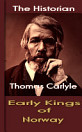
Early Kings of Norway: Restored Classics to Go Edition
About this ebook
Discover more
About the author
Thomas Carlyle was a Scottish essayist, historian, and social critic whose forceful prose and uncompromising vision made him one of the most influential voices of the nineteenth century. Born in 1795 in Ecclefechan, he was educated at the University of Edinburgh and began his career as a teacher before turning fully to writing, a path that led him from relative obscurity to wide intellectual prominence. Over the course of his life he produced a remarkable body of historical, philosophical, and critical work that helped shape modern ideas about history, leadership, labor, and moral responsibility. His writing is known for its intensity, vivid imagery, and conviction that history is driven not only by events but by character and purpose. Among his many achievements, he became especially important for reimagining the past as a field of dramatic human action, whether he was exploring heroic leadership, the dignity of work, or the spiritual crises of modern society. His central themes include the search for authentic greatness, the burden of duty, the dangers of materialism, and the need for meaning in public and private life, concerns that still resonate in an age of uncertainty and political noise. Carlyle's legacy endures because he challenged readers to think seriously about values, power, and the moral responsibilities of individuals and nations. He remains rewarding for readers who enjoy passionate prose, history with a philosophical edge, and writers who ask difficult questions about what gives life purpose.