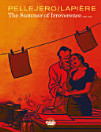
The summer of irreverence: Part One

The summer of irreverence Vol. 1 · Europe Comics
Llibre electrònic
56
Pàgines
Bubble Zoom
Apte

Sobre aquest llibre

Mexico, August 1923. Edward Weston has just abandoned his wife and children and joined his mistress Tina Modotti. Daughter of Italian emigrants, Tina started out on a career as a Hollywood actress before discovering a passion for photography, in Edward's wake. In Mexico, the lovers soon discover that revolution goes hand in hand with artistic expression. The walls of public institutions are colored with the vibrant paintings of Diego Rivera, Xavier Guerrero and all those who would go down in art history as ' the muralists.' In this pivotal period between the old world, still struggling in the aftermath of the First World War, and the new world, yet to be constructed, Tina and Edward become deeply involved in the artistic political movement of the epoch. For Tina, sex, freedom, art and politics become the pillars of her lifestyle, leading her to sometimes make choices that are difficult for Edward to deal with. But passion burns the senses, and suffering kindles the fires of creation...
Mexico, August 1923. Edward Weston has just abandoned his wife and children and joined his mistress Tina Modotti. Daughter of Italian emigrants, Tina started out on a career as a Hollywood actress before discovering a passion for photography, in Edward's wake. In Mexico, the lovers soon discover ...

Descobreix-ne més

Sobre l'autor

Born in 1958 in Namur, Denis Lapière started his sociology studies after having had a taste of the thrills of auto racing. In the mid-1980s he was one of the founders of the Tropica BD bookstore in Charleroi, which became the meeting point for many artists. Once he started getting some contacts, Lapière started writing scripts, which gradually found their place in the editorial landscape. He started at "Spirou," producing short stories. He then published his first book in 1987: "Mauro Caldi" (Éditions Michel Constant Mirror). In 1990, he started "Charly" with Magda, a fantasy thriller that had "Spirou" readers on the edge of their seats. In the years that followed, Denis wrote scripts for several titles in the Aire Libre collection at Dupuis, aimed toward adult readers. With Jean-Philippe Stassen, he created "Le Bar du Vieux Français," which won numerous awards around the world. For artist Paul Gillon, he wrote "La dernière des salles obscures" about the fate of a film producer during the twentieth century. While continuing his graphic novel collaborations (with Pellejero and Mezzomo in particular), Lapière continued to work on more family-orientated comics like "Ludo" (with Bailly and Mathy), "Oscar" (with Durieux), and the reboot of "Tif et Tondu" (with Sikorski). In the 2000s, Denis Lapière had several experiences as a film screenwriter (with Pierre-Paul Renders). He also tried out an editorial role (launching the collections "Punaise" and "Puceron" at Dupuis). In early 2010 he led two major projects: a collaborative series called "Alter Ego" and the new adventures of "Michel Vaillant" (Dupuis/Europe Comics), which he co-wrote with Philippe Graton. With nearly one hundred albums under his belt, Denis Lapière is one of today's most accomplished writers.

Born in 1958 in Namur, Denis Lapière started his sociology studies after having had a taste of the thrills of auto racing. In the mid-1980s he was one of the founders of the Tropica BD bookstore in Charleroi, which became the meeting point for many artists. Once he started getting some contacts, ...

Puntua aquest llibre electrònic

Dona'ns la teva opinió.

Informació de lectura

Telèfons intel·ligents i tauletes
Instal·la l'aplicació Google Play Llibres per a Android i per a iPad i iPhone. Aquesta aplicació se sincronitza automàticament amb el compte i et permet llegir llibres en línia o sense connexió a qualsevol lloc.
Ordinadors portàtils i ordinadors de taula
Pots escoltar els audiollibres que has comprat a Google Play amb el navegador web de l'ordinador.
Lectors de llibres electrònics i altres dispositius
Per llegir en dispositius de tinta electrònica, com ara lectors de llibres electrònics Kobo, hauràs de baixar un fitxer i transferir-lo al dispositiu. Segueix les instruccions detallades del Centre d'ajuda per transferir els fitxers a lectors de llibres electrònics compatibles.