À propos de cet e-book
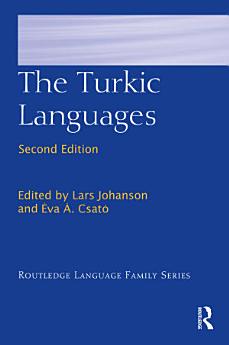
The Turkic Languages is a reference book which brings together detailed discussions of the historical development and specialized linguistic structures and features of the languages in the Turkic family. Seen from a linguistic typology point of view, Turkic languages are particularly interesting because of their astonishing morphosyntactic regularity, their vast geographical distribution, and their great stability over time.
This volume builds upon a work which has already become a defining classic of Turkic language study. The present, thoroughly revised edition updates and augments those authoritative accounts and reflects recent and ongoing developments in the languages themselves, as well as our further enhanced understanding of the relations and patterns of influence between them. The result is the fruit of decades-long experience in the teaching of the Turkic languages, their philology and literature, and also of a wealth of new insights into the linguistic phenomena and cultural interactions defining their development and use, both historically and in the present day.
Each chapter combines modern linguistic analysis with traditional historical linguistics; a uniform structure allows for easy typological comparison between the individual languages. Written by an international team of experts, The Turkic Languages will be invaluable to students and researchers within linguistics, Turcology, and Near Eastern and Oriental Studies.
Notes et avis
À propos de l'auteur
Lars Johanson, one of the world’s leading Turcologists, was born and educated at Uppsala University in Sweden. He is professor of Turcology at the University of Mainz, Germany. He has published widely on descriptive and historical linguistics, mostly focusing on the Turkic language family. His book Turkic (2021) presents his pioneering contributions to Turkic linguistics and language typology. He edits the journal Turkic Languages and the monograph series Turcologica.
Éva Á. Csató, born in Hungary, is professor emeritus in Turkic languages at Uppsala University, Sweden. She studied linguistics and Turcology at the University of Oslo. Her research interests include Turkic linguistics, syntactic typology, contact linguistics, documentation, and revitalization of endangered Turkic languages. She has published over 100 articles and edited more than 10 volumes on different Turkic linguistic topics. She is on the editorial board of the journal Turkic Languages.