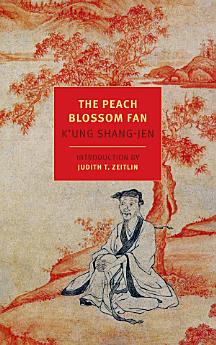
The Peach Blossom Fan
2015년 7월 · New York Review of Books
eBook
352
페이지
도구
info
family_home
적용 가능
info
eBook 정보
A tale of battling armies, political intrigue, star-crossed romance, and historical cataclysm, The Peach Blossom Fan is one of the masterpieces of Chinese literature, a vast dramatic composition that combines the range and depth of a great novel with the swift intensity of film.
In the mid-1640s, famine sweeps through China. The Ming dynasty, almost 300 years old, lurches to a bloody end. Peking falls to the Manchus, the emperor hangs himself, and Ming loyalists take refuge in the southern capital of Nanking. Two valiant generals seek to defend the city, but nothing can overcome the corruption, decadence, and factionalism of the court in exile. The newly installed emperor cares for nothing but theater, leaving practical matters to the insidious Ma Shih-ying. Ma’s crony Juan Ta-ch’eng is as unscrupulous an operator as he is sophisticated a poet. He diverts resources from the starving troops in order to stage a spectacular production of his latest play. History, however, has little time for make-believe, though the earnest members of the Revival Club, centered on the handsome young scholar Hou Fang-yü and his lover Fragrant Princess, struggle to discover a happy ending.
In the mid-1640s, famine sweeps through China. The Ming dynasty, almost 300 years old, lurches to a bloody end. Peking falls to the Manchus, the emperor hangs himself, and Ming loyalists take refuge in the southern capital of Nanking. Two valiant generals seek to defend the city, but nothing can overcome the corruption, decadence, and factionalism of the court in exile. The newly installed emperor cares for nothing but theater, leaving practical matters to the insidious Ma Shih-ying. Ma’s crony Juan Ta-ch’eng is as unscrupulous an operator as he is sophisticated a poet. He diverts resources from the starving troops in order to stage a spectacular production of his latest play. History, however, has little time for make-believe, though the earnest members of the Revival Club, centered on the handsome young scholar Hou Fang-yü and his lover Fragrant Princess, struggle to discover a happy ending.
A tale of battling armies, political intrigue, star-crossed romance, and historical cataclysm, The Peach Blossom Fan is one of the masterpieces of Chinese literature, a vast dramatic composition that combines the range and depth of a great novel with the swift intensity of film.
In the mid-1640...
콘텐츠 둘러보기
저자 정보
K'ung Shang-jen (1646–1718) was a sixty-fourth generation descendant of Confucius and was raised in his ancestor’s hometown of Qufu in Shandong province. A noted expert in music and Confucian rites, he was chosen in 1684 to lecture to the visiting emperor Kangxi, who later appointed him to the Imperial Academy in Beijing. The Peach Blossom Fan was completed in 1699 and was performed to great acclaim in 1700. It was not published, however, until 1708, a few years after K’ung had left his post and returned home to Qufu.
Judith T. Zeitlin is the William R. Kenan, Jr. Professor in East Asian Languages and Civilizations at the University of Chicago. Her most recent book is The Phantom Heroine: Ghosts and Gender in Seventeenth-Century Chinese Literature.
Chen Shih-Hsiang (1912–1971) was a professor of Chinese and comparative literature at the University of California, Berkeley. Among his books are The Genesis of Poetic Time and, with Harold Acton, Modern Chinese Poetry.
Harold Acton (1904–1994) was a prolific Anglo-Italian writer, poet, novelist, and translator. He lived in China from 1932 to ’39, teaching English literature at the University of Peking.
Cyril Birch is a translator and the Agassiz Professor of Chinese and Comparative Literature emeritus at the University of California, Berkeley.
K'ung Shang-jen (1646–1718) was a sixty-fourth generation descendant of Confucius and was raised in his ancestor’s hometown of Qufu in Shandong province. A noted expert in music and Confucian rites, he was chosen in 1684 to lecture to the visiting emperor Kangxi, who later appointed him to the Im...
이 eBook 평가
의견을 알려주세요.
읽기 정보
스마트폰 및 태블릿
노트북 및 컴퓨터
컴퓨터의 웹브라우저를 사용하여 Google Play에서 구매한 오디오북을 들을 수 있습니다.
eReader 및 기타 기기
Kobo eReader 등의 eBook 리더기에서 읽으려면 파일을 다운로드하여 기기로 전송해야 합니다. 지원되는 eBook 리더기로 파일을 전송하려면 고객센터에서 자세한 안내를 따르세요.