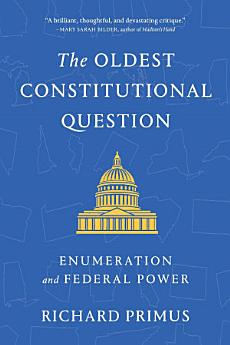
The Oldest Constitutional Question: Enumeration and Federal Power
červen 2025 · Harvard University Press - T
E‑kniha
448
Stránky
shoppingmodeU produktu 16. 10. klesla cena o 54 %
Podrobnosti o e‑knize
A groundbreaking challenge to a core principle of constitutional law, arguing that congressional action is not limited by the legislative branch’s textually enumerated powers.
Every law student learns that the federal government is constrained to act only according to its enumerated powers, meaning that Congress can do what the Constitution expressly authorizes it to and nothing more. Yet Richard Primus contends that this longstanding orthodoxy—allegedly required by the text of the Constitution, the Framers’ vision, and the logic of federalism—is fundamentally flawed.
Through careful analysis of constitutional text and history, and of the structure of American federalism, The Oldest Constitutional Question builds a powerful argument for broad congressional authority. In particular, Primus shows that the primary function of enumeration is to rule listed powers in, not to rule other powers out. The Framers were more worried that the federal government might be fragile and anemic than that it would be overwhelmingly strong. Enumerating congressional powers is thus best understood as a way of ensuring that the federal legislature has an incontestable warrant to exercise the powers specified there, not as an exhaustive description of all that Congress can do.
In practice, the enumeration of powers does little to limit Congress. But most constitutional lawyers—including many Supreme Court justices—think this means something has gone wrong, such that the courts must aggressively strike down federal laws exceeding Congress’s enumerated powers. Primus’s meticulous examination explodes the prevailing view, revealing its underlying errors. The constitutional system does place limits on Congress, and crucially so, but the enumeration of powers is not, and never has been, a sensible means for creating and enforcing those limits.
A groundbreaking challenge to a core principle of constitutional law, arguing that congressional action is not limited by the legislative branch’s textually enumerated powers.
Every law student learns that the federal government is constrained to act only according to its enumerated powers, mean...
Zjistit více
O autorovi
Richard Primus is Theodore J. St. Antoine Collegiate Professor at the University of Michigan Law School. He clerked for Justice Ruth Bader Ginsburg at the US Supreme Court and is the author of The American Language of Rights.
Richard Primus is Theodore J. St. Antoine Collegiate Professor at the University of Michigan Law School. He clerked for Justice Ruth Bader Ginsburg at the US Supreme Court and is the author of The American Language of Rights.
Ohodnotit e‑knihu
Sdělte nám, co si myslíte.
Informace o čtení
Telefony a tablety
Nainstalujte si aplikaci Knihy Google Play pro Android a iPad/iPhone. Aplikace se automaticky synchronizuje s vaším účtem a umožní vám číst v režimu online nebo offline, ať jste kdekoliv.
Notebooky a počítače
Audioknihy zakoupené na Google Play můžete poslouchat pomocí webového prohlížeče v počítači.
Čtečky a další zařízení
Pokud chcete číst knihy ve čtečkách elektronických knih, jako např. Kobo, je třeba soubor stáhnout a přenést do zařízení. Při přenášení souborů do podporovaných čteček elektronických knih postupujte podle podrobných pokynů v centru nápovědy.