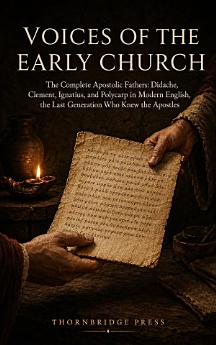
VOICES OF THE EARLY CHURCH: The Complete Apostolic Fathers: Didache, Clement, Ignatius, and Polycarp in Modern English, the Last Generation Who Knew the Apostles
About this ebook
Near the end of the first century, the generation that had walked with Jesus finished dying. Peter and Paul had been executed in Rome. John was gone, or nearly. What they left behind was not a New Testament, not a creed, and not an institution. It was a scattering of small congregations meeting after dark in borrowed rooms, arguing over who was in charge, unsure how to treat converts who sinned again, and with no reliable way to tell a faithful teacher from a fraud collecting free meals.
Four men wrote into that silence, and their words survived.
The Didache is a training manual, written to prepare a convert for baptism. It sets out two paths, one leading to life and one to death, and then gets startlingly practical: how to pray, how to fast, how to baptize when there is no river, and how to test a traveling preacher by watching what he asks for.
Clement of Rome wrote to a congregation in Corinth that had thrown out its own elders. He wrote from the church that had hosted Paul and, by tradition, watched Peter die. He held no jurisdiction over Corinth at all. What he had was memory, and it was enough.
Ignatius of Antioch wrote seven letters in chains, on a forced march toward the arena. He begged the congregations he would never see again to stay unified, and warned them against teachers who claimed Jesus had never truly bled.
Polycarp of Smyrna, appointed by the apostles themselves, wrote a plain pastoral letter to Philippi and then, decades later, walked into a stadium and refused to save his own life by denying what he had been given.
This volume presents all four in clear modern English, rendered fresh for this edition from the ancient sources, and arranged in the order their crises actually unfolded. Each text is followed by commentary explaining what was genuinely at stake for the people who first received it, and what it still asks of a church that continues to argue about leadership, still faces pressure from the culture around it, and still has to form believers who never met an apostle either.
Inside this volume:
Modern English renderings of the Didache, Clement to the Corinthians, the letters of Ignatius, Polycarp to the Philippians, and the account of Polycarp’s death. Sixteen chapters of commentary placing each document in the crisis that produced it. The two ways teaching examined in full, including its uncomfortable indictment of respectable indifference. How these writings survived, and why they were finally placed outside the canon. A timeline of the period, a glossary of names and terms, a note on the translation, and suggested further reading.
Written for readers of history, students of theology, teachers preparing a class, and anyone who has wondered what happened in the room after the apostles walked out of it.
Receive what was given. Pass it on without distortion. That was the whole task, and it still is.
Discover more
About the author
Thornbridge Press publishes the primary texts of the Christian tradition in
language a reader can actually follow. Its editions gather documents usually
scattered across academic volumes, render them in clear modern English, and
surround them with the historical context a reader needs to understand what
was genuinely at stake when they were written. The press works on a simple
conviction: that the writings which shaped the faith were produced by people
solving urgent, concrete problems, and that they read far better presented
that way than as museum pieces. Its catalogue spans the earliest Christian
centuries, and its editions are prepared for the ordinary reader first, with
the student and the teacher in mind throughout.