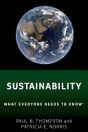
Sustainability: What Everyone Needs to Know®
janv. 2021 · Oxford University Press
E-book
224
Pages
family_home
Éligible
info
À propos de cet e-book
While politicians, entrepreneurs, and even school children could tell you that sustainability is an important and nearly universal value, many of them, and many of us, may struggle to define the term, let alone trace its history. What is sustainability? Is it always about the environment? What science do we need to fully grasp what it requires? What does sustainability mean for business? How can governments plan for a sustainable future? This short, accessible book written in the signature question-and-answer format of the What Everyone Needs to Know® series tackles these and numerous other questions. Sustainability is a porous topic, which has been adapted and reshaped for developing ecological models, improving corporate responsibility, setting environmental and land-use policies, organizing educational curricula, and reimagining the goals of governance and democracy. Where other treatments of this topic tend to focus on just one application of sustainability, this primer encompasses everything from global development and welfare to social justice and climate change. With chapters that discuss sustainability in the contexts of profitable businesses, environmental risks, scientific research, and the day-to-day business of local government, it gives readers a deep understanding of one of the most essential concepts of our time. Bringing to bear experience in natural resource conservation, agriculture, the food industry, and environmental ethics, authors Paul B. Thompson and Patricia E. Norris explain clearly what sustainability means, and why getting it right is so important for the future of our planet.
While politicians, entrepreneurs, and even school children could tell you that sustainability is an important and nearly universal value, many of them, and many of us, may struggle to define the term, let alone trace its history. What is sustainability? Is it always about the environment? What sc...
En voir d'autres
À propos de l'auteur
Paul B. Thompson is trained in philosophy and has spent a career of research and writing with a focus on technological risks and on ethical questions that arise in connection with agriculture and the food system. He is the W.K. Kellogg Chair in Agricultural Food and Community Ethics at Michigan State University, and author of numerous articles. His book From Field to Fork: Food Ethics for Everyone was published by Oxford University Press in 2015. It won the "Book of the Year" award for 2015 from the North American Society for Social Philosophy. Patricia E. Norris is a natural resource economist with a specialization in the economics and policy of natural resources and the environment. Her academic career has focused on land and water management and policy with a focus on how public and private interests are reconciled. She is the Gordon and Norma Guyer and Gary L. Seevers Chair in Natural Resource Conservation at Michigan State University.
Paul B. Thompson is trained in philosophy and has spent a career of research and writing with a focus on technological risks and on ethical questions that arise in connection with agriculture and the food system. He is the W.K. Kellogg Chair in Agricultural Food and Community Ethics at Michigan S...
Donner une note à cet e-book
Dites-nous ce que vous en pensez.
Informations sur la lecture
Smartphones et tablettes
Installez l'application Google Play Livres pour Android et iPad ou iPhone. Elle se synchronise automatiquement avec votre compte et vous permet de lire des livres en ligne ou hors connexion, où que vous soyez.
Ordinateurs portables et de bureau
Vous pouvez écouter les livres audio achetés sur Google Play à l'aide du navigateur Web de votre ordinateur.
Liseuses et autres appareils
Pour lire sur des appareils e-Ink, comme les liseuses Kobo, vous devez télécharger un fichier et le transférer sur l'appareil en question. Suivez les instructions détaillées du Centre d'aide pour transférer les fichiers sur les liseuses compatibles.