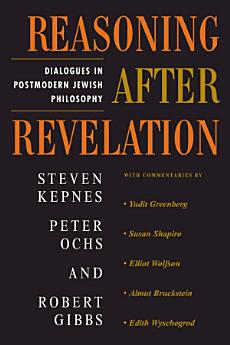
Reasoning After Revelation: Dialogues In Postmodern Jewish Philosophy
Mar 2018 · Routledge
Ebook
176
Pages
family_home
Eligible
info
About this ebook
In Reasoning After Revelation: Dialogues in Postmodern Jewish Philosophy, three preeminent Jewish scholars debate the form and meaning of Postmodern Jewish Philosophy after the failures of the great secular ideologies of modern western civilization. Emulating the methods as well as the premises of Talmudic argumentation, the authors present their responses as dialogues joined by a common love of the rabbinic tradition of commentary and interpretation of the Bible. The composers, Peter Ochs, Robert Gibbs, and Steven Kepnes, contemplate where Judaism has beenand where it is headed: on what basis will modern Jews now reason about the meaning of Jewish existence and the relevance of age-old Biblical traditions to the moral and social crises of the twenty-first century? The dialogues are further enriched by a set of responses from leading Jewish philosophers: Elliot R. Wolfson, Edith Wyschogrod, Almut Sh. Bruckstein, Yudit Kornberg Greenberg, and Susan E. Shapiro. }Postmodern Jewish thinkers understand their Jewishness differently, but they all share a fidelity to what they call the Torah and to communal practices of reading and social action that have their bases in rabbinic interpretations of biblical narrative, law, and belief. Thus, postmodern Jewish thinking is thinking about God, Jews, and the worldwith the texts of the Torahin the company of fellow seekers and believers. It utilizes the tools of philosophy, but without their modern premises. Moreover, this form of Jewish thinking provides resources for philosophically disciplined readings of scripture by Jews, Christians, and Moslems seeking alternatives to the reductive discourses of secular academia, on the one hand, and to antimodern religious fundamentalisms, on the other. Postmodern Jewish Philosophy aims to utilize rabbinic modes of thinking to provide a model for ethical and religious thought in the twenty-first century, one which moves beyond the dichotomy of relativism and imperialism and is simultaneously definite and pluralistic. In Reasoning After Revelation: Dialogues in Postmodern Jewish Philosophy, three preeminent Jewish scholars debate the form and meaning of Postmodern Jewish Philosophy after the failures of the great secular ideologies of modern western civilization. Emulating the methods as well as the premises of Talmudic argumentation, the authors present their responses as dialogues joined by a common love of the rabbinic tradition of commentary and interpretation of the Bible. The composers, Peter Ochs, Robert Gibbs, and Steven Kepnes, contemplate where Judaism has beenand where it is headed: on what basis will modern Jews now reason about the meaning of Jewish existence and the relevance of age-old Biblical traditions to the moral and social crises of the twenty-first century? The dialogues are further enriched by a set of responses from leading Jewish philosophers: Elliot R. Wolfson, Edith Wyschogrod, Almut Sh. Bruckstein, Yudit Kornberg Greenberg, and Susan E. Shapiro.
In Reasoning After Revelation: Dialogues in Postmodern Jewish Philosophy, three preeminent Jewish scholars debate the form and meaning of Postmodern Jewish Philosophy after the failures of the great secular ideologies of modern western civilization. Emulating the methods as well as the premises o...
Discover more
Rate this ebook
Tell us what you think.
Reading information
Smartphones and tablets
Install the Google Play Books app for Android and iPad/iPhone. It syncs automatically with your account and allows you to read online or offline wherever you are.
Laptops and computers
You can listen to audiobooks purchased on Google Play using your computer's web browser.
eReaders and other devices
To read on e-ink devices like Kobo eReaders, you'll need to download a file and transfer it to your device. Follow the detailed Help Center instructions to transfer the files to supported eReaders.