Acerca de este libro electrónico
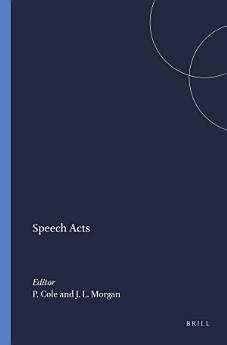
Both linguists and philosophers have, for a number of years, been interested in the concept of speech acts, first proposed by J. L. Austin; but each discipline has remained uniformed on the often parallel work of the other. This volume brings together linguistic and philosophical approaches to speech acts, in order to bring out agreements and disagreements.
Many of the articles focus on the problem of indirect speech acts, or "conversational implicature".Such indirect speech acts are a major impediment to a coherent, explanatory account of the relation between sound and meaning, since it is not clear whether the use of a sentence to perform and indirect speech act is part of the sentence's linguistically significant meaning, to be handled by syntactic rules, or whether this use is best explained on some other basis, such as a theory of language use. In this volume, such philosophers as John Searle and H. P. Grice examine the relation between the content of a sentence and the conditions under which it can be used to perform a given speech act, while such linguists as John Robert Ross, Georgia M. Green, and Jerrold M. Sadock show that the illocutionary intent of a speaker is often reflected in the syntactic properties of the sentence he uses.
This book, with its full airing of the controversy regarding the status of conversational implicature and syntactic rules, will be invaluable to both linguists and philosophers concerned with semantics and pragmatics.
Both linguists and philosophers have, for a number of years, been interested in the concept of speech acts, first proposed by J. L. Austin; but each discipline has remained uniformed on the often parallel work of the other. This volume brings together linguistic and philosophical approaches to sp...
Califica este libro electrónico
Cuéntanos lo que piensas.
Información de lectura
Smartphones y tablets
Instala la app de Google Play Libros para Android y iPad/iPhone. Como se sincroniza de manera automática con tu cuenta, te permite leer en línea o sin conexión en cualquier lugar.
Laptops y computadoras
Para escuchar audiolibros adquiridos en Google Play, usa el navegador web de tu computadora.
Lectores electrónicos y otros dispositivos
Para leer en dispositivos de tinta electrónica, como los lectores de libros electrónicos Kobo, deberás descargar un archivo y transferirlo a tu dispositivo. Sigue las instrucciones detalladas que aparecen en el Centro de ayuda para transferir los archivos a lectores de libros electrónicos compatibles.