關於本電子書
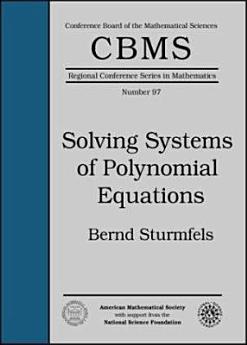
A classic problem in mathematics is solving systems of polynomial equations in several unknowns. Today, polynomial models are ubiquitous and widely used across the sciences. They arise in robotics, coding theory, optimization, mathematical biology, computer vision, game theory, statistics, and numerous other areas. This book furnishes a bridge across mathematical disciplines and exposes many facets of systems of polynomial equations. It covers a wide spectrum of mathematical techniques and algorithms, both symbolic and numerical.The set of solutions to a system of polynomial equations is an algebraic variety - the basic object of algebraic geometry. The algorithmic study of algebraic varieties is the central theme of computational algebraic geometry. Exciting recent developments in computer software for geometric calculations have revolutionized the field. Formerly inaccessible problems are now tractable, providing fertile ground for experimentation and conjecture. The first half of the book gives a snapshot of the state of the art of the topic. Familiar themes are covered in the first five chapters, including polynomials in one variable, Grobner bases of zero-dimensional ideals, Newton polytopes and Bernstein's Theorem, multidimensional resultants, and primary decomposition.The second half of the book explores polynomial equations from a variety of novel and unexpected angles. It introduces interdisciplinary connections, discusses highlights of current research, and outlines possible future algorithms. Topics include computation of Nash equilibria in game theory, semidefinite programming and the real Nullstellensatz, the algebraic geometry of statistical models, the piecewise-linear geometry of valuations and amoebas, and the Ehrenpreis-Palamodov theorem on linear partial differential equations with constant coefficients.Throughout the text, there are many hands-on examples and exercises, including short but complete sessions in MapleR, MATLABR, Macaulay 2, Singular, PHCpack, CoCoA, and SOSTools software. These examples will be particularly useful for readers with no background in algebraic geometry or commutative algebra. Within minutes, readers can learn how to type in polynomial equations and actually see some meaningful results on their computer screens. Prerequisites include basic abstract and computational algebra. The book is designed as a text for a graduate course in computational algebra.
A classic problem in mathematics is solving systems of polynomial equations in several unknowns. Today, polynomial models are ubiquitous and widely used across the sciences. They arise in robotics, coding theory, optimization, mathematical biology, computer vision, game theory, statistics, and nu...
瀏覽更多書籍
為這本電子書評分
歡迎提供意見。
閱讀資訊
智慧型手機與平板電腦
筆記型電腦和電腦
你可以使用電腦的網路瀏覽器聆聽你在 Google Play 購買的有聲書。
電子書閱讀器與其他裝置
如要在 Kobo 電子閱讀器這類電子書裝置上閱覽書籍,必須將檔案下載並傳輸到該裝置上。請按照說明中心的詳細操作說明,將檔案傳輸到支援的電子閱讀器上。