About this ebook
Most Android security resources give you a checklist: encrypt this, pin that, don't hardcode secrets. This book teaches you the mental model underneath the checklist.
If you've ever wondered why an exported Activity becomes a real attack path, what SELinux is actually enforcing when it blocks a syscall, how a key can live in the Android Keystore and never once touch app memory, or why SSL pinning bypass in Frida still doesn't mean the backend is safe — this is the book that answers those questions from the inside out.
Android Security: From Fundamentals to Advanced Practice takes you from the Linux kernel and the app sandbox to the deepest layers of the platform: SELinux domains and Mandatory Access Control, the Verified Boot trust chain, TrustZone and StrongBox Keymaster, and the exact mechanics behind Smali patching, Frida instrumentation, and exploit-primitive research. You won't just learn what to fix — you'll learn why the vulnerability exists in the first place, so you can threat-model with intention, harden systems that don't have a CVE yet, and reason confidently about bugs no checklist has covered.
Inside, you'll learn:
How the Android security model actually enforces isolation — UID sandboxing, SELinux contexts, and permission evolution from install-time to runtime to granular media access
The full lifecycle of a cryptographic key: Keystore internals, hardware-backed attestation, Passkeys, and exactly how crypto misuse (ECB mode, weak IVs) gets exploited
How static and dynamic analysis really work — decompiling Smali and Kotlin bytecode, Frida hooking, and bypassing SSL pinning and root detection (then hardening against your own bypass)
How to reverse-engineer native code across the JNI boundary and reason about commercial packers without a defeat-guide mindset
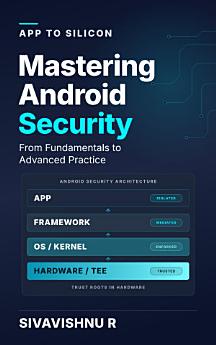
The Verified Boot chain and TrustZone/TEE internals — the silicon-level guarantees everything else in the book relies on
Vulnerability research fundamentals: fuzzing intents and system services, triaging findings, and the shift toward Rust for memory safety in AOSP
Malware analysis from the inside — safe sandboxing, behavioral triage, and C2 detection patterns
A complete throughline of real, publicly documented cases — Stagefright, WebView RCEs, a banking trojan family, and real CVEs — walked root-cause to fix, that ties every technique to something that actually happened in the wild
Whether you're an app developer who wants to stop shipping vulnerabilities, a pentester building toward CVE research, a reverse engineer moving from Java into native and Kotlin-aware analysis, or a security researcher chasing the next zero-day, this book gives you the mental model professional Android security engineers use — from the app you wrote down to the silicon it runs on.
No fluff. No surface-level checklists. Just a rigorous, complete map of how Android security really works.