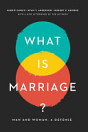
What Is Marriage?: Man and Woman: A Defense
Feb 2012 · Encounter Books
star
10 reviews
Ebook
150
Pages
Tools
info
About this ebook
Until just yesterday, no society--monogamous or polygamous—had defined marriage as anything other than a male-female union. With clear and cogent arguments, What Is Marriage? explains the rational basis of this historic consensus. It defeats the arguments for recognizing same-sex partnerships as marriages and shows how doing so would harm the common good.
Originally published in the Harvard Journal of Law and Public Policy, this book’s core argument quickly became the year’s most widely read essay of more than 300,000 scholarly articles posted on the Social Sciences Research Network. Now expanded to address a flurry of prominent responses, What Is Marriage? stands poised to meet its moment as few books of this generation have. If the marriage debate in America is decided in the next few years, it will be either with this book’s help, or despite its powerful arguments.
Rhodes Scholar Sherif Girgis, Princeton University professor Robert P. George, and Ryan T. Anderson, editor of the online journal Public Discourse, provide a devastating critique of the claim that equality requires redefining marriage. They point out that any assessment of what “marriage equality” demands depends on first determining what marriage is—what sort of relationships must be treated as essentially the same. They defend the principle that marriage, as a comprehensive union ordered to family life, requires a man and a woman. And they argue for the great social benefits of enshrining this principle in law.
Most compellingly, they show that those who embrace same-sex civil marriage leave themselves no firm ground—none—for not recognizing as marriages every relationship type describable in polite English, including multiple-partner (“polyamorous”) sexual unions.
Finally, What Is Marriage? decisively answer common objections: that the historic view is rooted in bigotry (like laws forbidding interracial marriage); that it is callous to people’s needs; that it can’t show the harm of recognizing same-sex couplings, or the point of recognizing infertile ones; and that it treats a mere “social construct” as if it were natural, or an unreasoned religious view as if it were rational.
Originally published in the Harvard Journal of Law and Public Policy, this book’s core argument quickly became the year’s most widely read essay of more than 300,000 scholarly articles posted on the Social Sciences Research Network. Now expanded to address a flurry of prominent responses, What Is Marriage? stands poised to meet its moment as few books of this generation have. If the marriage debate in America is decided in the next few years, it will be either with this book’s help, or despite its powerful arguments.
Rhodes Scholar Sherif Girgis, Princeton University professor Robert P. George, and Ryan T. Anderson, editor of the online journal Public Discourse, provide a devastating critique of the claim that equality requires redefining marriage. They point out that any assessment of what “marriage equality” demands depends on first determining what marriage is—what sort of relationships must be treated as essentially the same. They defend the principle that marriage, as a comprehensive union ordered to family life, requires a man and a woman. And they argue for the great social benefits of enshrining this principle in law.
Most compellingly, they show that those who embrace same-sex civil marriage leave themselves no firm ground—none—for not recognizing as marriages every relationship type describable in polite English, including multiple-partner (“polyamorous”) sexual unions.
Finally, What Is Marriage? decisively answer common objections: that the historic view is rooted in bigotry (like laws forbidding interracial marriage); that it is callous to people’s needs; that it can’t show the harm of recognizing same-sex couplings, or the point of recognizing infertile ones; and that it treats a mere “social construct” as if it were natural, or an unreasoned religious view as if it were rational.
Until just yesterday, no society--monogamous or polygamous—had defined marriage as anything other than a male-female union. With clear and cogent arguments, What Is Marriage? explains the rational basis of this historic consensus. It defeats the arguments for recognizing same-sex partnerships as ...
Ratings and reviews
10 reviews

Robert Godfrey
- Flag inappropriate
January 9, 2015
I think this is an essential book for any one on either side of the gay marriage debate. While I don't agree 100% with everything they say, I agree with their basic conclusion. I don't get the impression that they are "gay haters" which is good because I don't feel I am one either and certainly don't want to promote a book that advocates such a stance.

Bruce Cartland
- Flag inappropriate
October 24, 2017
A very detailed logical and secular analysis without reference to any religious notions. A valuable and polite contribution.
About the author
Sherif Girgis is a Ph.D. student in philosophy at Princeton University and a J.D. candidate at Yale Law School. After graduating Phi Beta Kappa and summa cum laude from Princeton, where he had won prizes for best senior thesis in ethics and best thesis in philosophy, as well as the Dante Society of America’s national Dante Prize, he obtained a B.Phil. in moral, political, and legal philosophy from the University of Oxford as a Rhodes Scholar.
Ryan T. Anderson is William E. Simon Fellow at the Heritage Foundation and the editor of Public Discourse: Ethics, Law, and the Common Good, the online journal of the Witherspoon Institute. A Phi Beta Kappa and magna cum laude graduate of Princeton University, he is a doctoral candidate in political philosophy at the University of Notre Dame. He has worked as assistant editor of First Things and was a Journalism Fellow of the Phillips Foundation. His writings have appeared in the Harvard Journal of Law and Public Policy, First Things, the Weekly Standard, National Review, the New Atlantis, and the Claremont Review of Books.
Robert P. George is a Visiting Professor at Harvard Law School and McCormick Professor of Jurisprudence and Director of the James Madison Program in American Ideals and Institutions at Princeton University. He is a member of the United States Commission on International Religious Freedom, and previously served on the President's Council on Bioethics and as a presidential appointee to the United States Commission on Civil Rights. He is a former Judicial Fellow at the Supreme Court of the United States, where he received the Justice Tom C. Clark Award. He is a recipient of the United States Presidential Citizens Medal and the Honorific Medal for the Defense of Human Rights of the Republic of Poland.
Ryan T. Anderson is William E. Simon Fellow at the Heritage Foundation and the editor of Public Discourse: Ethics, Law, and the Common Good, the online journal of the Witherspoon Institute. A Phi Beta Kappa and magna cum laude graduate of Princeton University, he is a doctoral candidate in political philosophy at the University of Notre Dame. He has worked as assistant editor of First Things and was a Journalism Fellow of the Phillips Foundation. His writings have appeared in the Harvard Journal of Law and Public Policy, First Things, the Weekly Standard, National Review, the New Atlantis, and the Claremont Review of Books.
Robert P. George is a Visiting Professor at Harvard Law School and McCormick Professor of Jurisprudence and Director of the James Madison Program in American Ideals and Institutions at Princeton University. He is a member of the United States Commission on International Religious Freedom, and previously served on the President's Council on Bioethics and as a presidential appointee to the United States Commission on Civil Rights. He is a former Judicial Fellow at the Supreme Court of the United States, where he received the Justice Tom C. Clark Award. He is a recipient of the United States Presidential Citizens Medal and the Honorific Medal for the Defense of Human Rights of the Republic of Poland.
Sherif Girgis is a Ph.D. student in philosophy at Princeton University and a J.D. candidate at Yale Law School. After graduating Phi Beta Kappa and summa cum laude from Princeton, where he had won prizes for best senior thesis in ethics and best thesis in philosophy, as well as the Dante Society ...
Rate this ebook
Tell us what you think.
Reading information
Smartphones and tablets
Install the Google Play Books app for Android and iPad/iPhone. It syncs automatically with your account and allows you to read online or offline wherever you are.
Laptops and computers
You can listen to audiobooks purchased on Google Play using your computer's web browser.
eReaders and other devices
To read on e-ink devices like Kobo eReaders, you'll need to download a file and transfer it to your device. Follow the detailed Help Center instructions to transfer the files to supported eReaders.