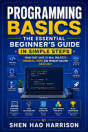
Database Foundations: SQL, NoSQL, and Essential Data Skills for Beginners: The Simplified Guide to Querying, Designing, and Managing Modern Databases
About this ebook
The book begins by explaining what databases are and why they matter, showing how they power everyday applications, from social media and online shopping to banking and healthcare systems. It introduces the two main database categories—SQL (structured, table-based) and NoSQL (flexible, varied formats)—with clear comparisons and guidance on when to use each. Tables, rows, columns, data types, primary keys, and foreign keys are explained through relatable analogies and real-world examples.
SQL fundamentals are covered in depth, walking readers through the four essential commands: SELECT for retrieving data, INSERT for adding new data, UPDATE for modifying existing data, and DELETE for removing data. Filtering and sorting techniques with WHERE and ORDER BY are demonstrated through practical examples, along with advanced filtering using AND, OR, LIKE, and BETWEEN. JOIN operations—INNER JOIN, LEFT JOIN, RIGHT JOIN, and FULL JOIN—are explained through the analogy of investigating connected information across multiple tables.
NoSQL databases are made simple through explanations of document stores (MongoDB), key-value stores (Redis), wide-column stores (Cassandra), and graph databases (Neo4j), with practical query examples and guidance on when to choose NoSQL over SQL. Database design principles cover normalization, relationship patterns (one-to-many, many-to-many, and one-to-one), and performance trade-offs, including denormalization and indexing strategies.
Key Topics Covered:
• What Is a Database: Why databases matter, how they work, SQL vs. NoSQL, and common myths.
• Understanding Data & Tables: Tables, rows, columns, data types, primary keys, foreign keys, and common pitfalls.
• Getting Started with SQL: SELECT, INSERT, UPDATE, and DELETE commands with hands-on examples.
• Filtering & Sorting Data: WHERE, AND, OR, LIKE, BETWEEN, ORDER BY, and combining conditions.
• Joining Tables & Relationships: INNER JOIN, LEFT JOIN, RIGHT JOIN, FULL JOIN, self-joins, and multi-table queries.
• NoSQL Databases Made Simple: Document stores, key-value stores, wide-column stores, graph databases, and query examples.
• Database Design: Normalization rules, relationship patterns, SQL vs. NoSQL design, performance trade-offs, and indexing strategies.
• Essential Data Skills: Data import and export (CSV and JSON), backup strategies, security essentials (least privilege and parameterized queries), and performance optimization (EXPLAIN and indexing).
• Working with Real-World Data: Data cleaning techniques, exploratory data analysis, visualization essentials, and data quality checklists.
• Next Steps & Resources: Career paths (SQL specialist, NoSQL developer, data analyst), tools, certifications, learning resources, and a 30-day action plan.
Discover more
About the author
Shen Hao Harrison is a tech enthusiast, futurist, and storyteller who breaks down complex technological concepts into clear, practical lessons. For over a decade, he has helped individuals and organizations understand the digital forces shaping our world. His writing blends analytical clarity with creative foresight, making technology accessible to everyone. He speaks at international tech events and contributes to leading technology publications. When not writing, he explores the frontiers of AI, practices martial arts (Wushu), and considers the philosophical implications of human-machine interaction.