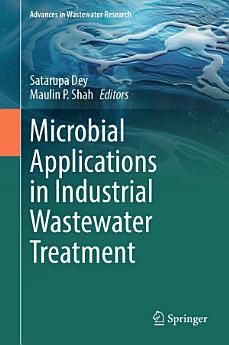
Microbial Applications in Industrial Wastewater Treatment

·
· Springer Nature
Ebook
392
Pages

About this ebook

This book explores the latest development on bioremediation techniques of wastewater pollutants using microbes. They can be used to valorize nutrients from wastewater systems and produce biodiesel, bioethanol and other biofuels. Furthermore, polymers such as poly hydroxybutyric acids and other extra cellular polysaccharides obtained from these microbes can also be utilized for the production of bioplastics, different biopolymers and biosurfactants. The book is divided into three parts, including (1) bioremediation by microbes, (2) resource recovery by microbes and (3) genomics and proteomics associated with bioremediation. The volume is a valuable resource for researchers, students, academicians and policymakers in the field of wastewater treatment.
This book explores the latest development on bioremediation techniques of wastewater pollutants using microbes. They can be used to valorize nutrients from wastewater systems and produce biodiesel, bioethanol and other biofuels. Furthermore, polymers such as poly hydroxybutyric acids and other ex...

Discover more

About the author

Satarupa Dey is an assistant professor in the Department of Botany, Shyampur Siddheswari Mahavidyalaya, affiliated under the University of Calcutta, West Bengal, India. She was awarded her Ph.D. from the University of Calcutta. Her research expertise is bioremediation of toxic metals. She was selected as a research fellow of the Department of Biotechnology, Government of India, and later she worked as a visiting scientist in the Agricultural and Ecological Research Unit of Indian Statistical Institute, Kolkata. She is the recipient of the Woman Scientist fellowship and start up grant from the Department of Science and Technology, Government of India. Her primary research interests include bioremediation of toxic heavy metals, plant growth promoting microbiome and microplastic bioremediation. She has published many journal articles and book chapters.

Dr. Maulin P. Shah is interested in genetic adaptation processes in bacteria, the mechanisms by which they deal with toxic substances, how they react to pollution in general and how we can apply microbial processes in a useful way (for example, bacterial bioreporters). One of his major interests is to study how bacteria evolve and adapt to use organic pollutants as novel growth substrates. His research work focuses on the impact of industrial pollution on microbial diversity in wastewater though cultivation dependant and cultivation independent analyses. His major work involves isolation, screening, identification and genetic engineering of microbes for the degradation of hazardous materials. He has more than 450 research publications in highly reputed national and international journals. He manages the research programs at Enviro Technology Ltd., Ankleshwar, India. He also serves as a reviewer in various academic journals.
Satarupa Dey is an assistant professor in the Department of Botany, Shyampur Siddheswari Mahavidyalaya, affiliated under the University of Calcutta, West Bengal, India. She was awarded her Ph.D. from the University of Calcutta. Her research expertise is bioremediation of toxic metals. She was sel...

Rate this ebook

Tell us what you think.

Reading information

Smartphones and tablets
Install the Google Play Books app for Android and iPad/iPhone. It syncs automatically with your account and allows you to read online or offline wherever you are.
Laptops and computers
You can listen to audiobooks purchased on Google Play using your computer's web browser.
eReaders and other devices
To read on e-ink devices like Kobo eReaders, you'll need to download a file and transfer it to your device. Follow the detailed Help Center instructions to transfer the files to supported eReaders.