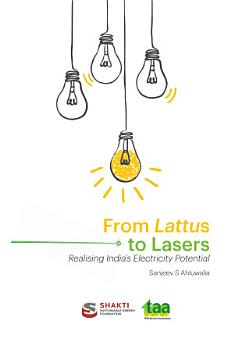
About this ebook
… most impressive is the vast historical canvass it covers placing the electricity sector in the framework of national economic ‘reform’ leading to industry restructuring and the introduction of autonomous regulation, which remain works in progress.
Dr Pramod Deo, former Chairman, CERC
… encapsulates an ‘electric’ journey of over a 100 years in a succinct yet comprehensive manner. It is a key to understanding the fundamentals of the Indian electricity sector.
Gireesh B Pradhan, former Chairman, CERC and former Secretary, MNRE
An innocuous subject like electricity springs to life when viewed through the lens of a seasoned policy analyst and researcher. Weaves an intricate tale of the twists and turns of the electricity sector from the restrictive days of colonial rule through consolidation to its present-day spread across the country. The finale is a transformational framework to make the sector future-ready, although … the proposal of multi-state electricity regulators does not fi t the context of India’s fractious and divisive politics.
Prabir Neogi, Chief Advisor (Corporate Affairs), RP-Sanjiv Goenka Group
… does not stop at only presenting the history and challenges … also proposes bold reform measures, including privatization of distribution and establishment of regional regulators. There may be divergent opinions about some of the measures, but I am sure every stakeholder will agree with the following observation, “India needs to enhance its energy resilience and security. This is possible if the spirit of cooperative federalism suff uses institutional arrangements and public interest trumps political upmanship.”
Shantanu Dixit, Prayas (Energy Group), Pune
Contents:
Foreword
Preface
Introduction
Electricity dispels the darkness
The origins of electricity
The colonial period: electricity for the elite: 1950–1984
Democratizing electricity supply
The Electricity (Supply) Act, 1948
Central planning favours public investment-led development
The Industrial Policy Resolution, 1956
The fiscal cost of public electricity supply
Electricity-intensive development
Changes in consumption pattern
The return of private investment: 1985–2020
International comparison of electricity supply
Profligate use of electricity shunned
Incentives for electricity reform
Union government’s initiatives for structural reform in electricity
The outcomes of reforms
The end of supply shortages
Generation capacity utilization lower than optimal
Transmission shines
Private power exchanges
Discoms: the weakest link in the value chain
The unfinished reforms agenda
Planned electricity development: supply-side triumph or copycat industrial policy?
Putting industrial development above basic social and human needs
Throwing out the baby with the bathwater
Misallocation of public funds
Borrowed templates
Path dependency
Economic growth and competitiveness
New pathologies
Unresolved issues in electricity supply
Electricity suppliers: too few or too many?
Has competition in supply increased?
Has the unbundling splintered supply to unviable levels?
Measures to enhance competition
Autonomy for regulators
The needs of viable power markets
The need for a ‘smart’ grid
Four short-term hard choices
Trends favouring India
High growth can make green power affordable
Renewable and hydroelectricity offer unutilized potential
Growth of digital connectivity
Symmetric policy preferences across parties
Bibliography and notes
Audience: Adults who are concerned about topical issues but lack the understanding to make sense of what they read or watch in the mass media
Shelving: Energy, Power, Mechanical Engineering
Discover more
Ratings and reviews
About the author
Sanjeev S Ahluwalia is Advisor, Observer Research Foundation and an honorary member of the Governing Council of the CUTS Institute for Regulation and Competition. He was the founder Secretary of the Central Electricity Regulatory Commission in 1999–2000. In TERI (1996– 98) he provided technical assistance to the newly corporatized utility gridco for its first tariff application to the OERC, under the Orissa Electricity Reform Project assisted by the World Bank and DfID. His core skills are in governance and institutional analysis, energy and economic regulation and public financial management backed by eight years with the Poverty Reduction and Economic Management practice of the World Bank in Africa. In the Government of India, he worked on privatizing state owned enterprises, facilitating trade development with East Asia and regulating private external, commercial debt. His home cadre in the Indian Administrative Service was Uttar Pradesh, where he worked as Secretary, Finance. He hosts a Blog—Opinion India (www.ahlu-india.com) and has over 200 published opinion pieces in orfonline.org, Asian Age and other media outlets.