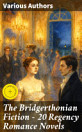
The Bridgerthonian Fiction - 20 Regency Romance Novels: Fantomina, Belinda, The Wanderer, Sense and Sensibility, Vanity Fair, Anti-Pamela, Miss Marjoribanks...
Samuel Richardson · Jane Austen · Maria Edgeworth · Henry Fielding · Mary Wollstonecraft · William Makepeace Thackeray · Fanny Burney · Georgette Heyer · Eliza Haywood · Leo Tolstoy · Mrs. Olifant
Nov 2023 · DigiCat
Ebook
11661
Pages
family_home
Eligible
info
About this ebook
The Bridgerthonian Fiction - 20 Regency Romance Novels is a vibrant anthology that weaves together diverse literary innovations that flourished during and inspired by the Regency era. Embodying the essence of love and society's intricate dance, the collection transcends traditional romance, illustrating timeless themes of class, duty, and passion. Carefully curated to showcase a plethora of narrative styles—from the epistolary novel to the biting satirical prose—the anthology includes works that challenge conventions and highlight the dynamic intricacies of human relationships. Readers encounter both groundbreaking narratives and hidden gems that cumulatively enrich our understanding of Regency literature's cultural and emotional landscapes. The anthology is graced by the voices of esteemed authors who capture the zeitgeist of their respective periods while influencing successive generations. Samuel Richardson and Henry Fielding provide depth to the themes of virtue and moral complexity, while Jane Austen and Georgette Heyer elevate the genre with their pioneering explorations of social intricacies and romantic ideals. Moreover, the inclusion of Maria Edgeworth and Mary Wollstonecraft honors the empowering perspectives that these women brought to the 18th and 19th-century literary tradition, illustrating the shifting perspectives on gender dynamics. Each author's unique perspective merges within this anthology to form a comprehensive dialogue on love's evolving representation. Engaging readers with a wide-ranging spectrum of narrative techniques, The Bridgerthonian Fiction offers an unparalleled passage into the heart of Regency romance. It invites both scholars and enthusiasts to immerse themselves in its expansive narrative universe, fostering a nuanced appreciation of period-specific societal evolutions. This volume not only highlights the individual brilliance of its contributors but also serves as a gateway to grasping the collective shifts in literary and romantic thought throughout history. Exploring this anthology promises a rewarding journey through its rich tapestry of voices and envisionings.
The Bridgerthonian Fiction - 20 Regency Romance Novels is a vibrant anthology that weaves together diverse literary innovations that flourished during and inspired by the Regency era. Embodying the essence of love and society's intricate dance, the collection transcends traditional romance, illus...
Discover more
About the author
Samuel Richardson (1689–1761) was an eminent English writer and printer known for his epistolary novels. Richardson's contribution to English literature lies in his innovative use of the epistolary form, which involves constructing a novel entirely through a sequence of letters. Although 'The Bridgerthonian Fiction - 20 Regency Romance Novels' does not conform to his known bibliography, Richardson is renowned for his three major novels. His first significant work, 'Pamela, or Virtue Rewarded' (1740), is considered one of the earliest English novels. It presents a didactic tale of a servant girl's struggles against her master's seduction attempts followed by a moral evolution of both characters. His subsequent novel, 'Clarissa, or, the History of a Young Lady' (1748), further cemented his standing as a moralist and a sentimentalist, depicting a tragic confrontation between a virtuous heroine and a rakish antagonist. Richardson's final novel, 'The History of Sir Charles Grandison' (1753), was less popular but still noteworthy for its portrayal of a male protagonist embodying ideal conduct. Richardson's literary style reflects a meticulous psychological realism and depth of character, influencing successors like Jane Austen, and resonates with themes of virtue, morality, and the complexities of social conduct in the 18th century. Richardson's novels are studied for their intricate portrayal of gender dynamics and moral discourse that encapsulate the sensibilities of his era.
Samuel Richardson (1689–1761) was an eminent English writer and printer known for his epistolary novels. Richardson's contribution to English literature lies in his innovative use of the epistolary form, which involves constructing a novel entirely through a sequence of letters. Although 'The Bri...
Rate this ebook
Tell us what you think.
Reading information
Smartphones and tablets
Install the Google Play Books app for Android and iPad/iPhone. It syncs automatically with your account and allows you to read online or offline wherever you are.
Laptops and computers
You can listen to audiobooks purchased on Google Play using your computer's web browser.
eReaders and other devices
To read on e-ink devices like Kobo eReaders, you'll need to download a file and transfer it to your device. Follow the detailed Help Center instructions to transfer the files to supported eReaders.