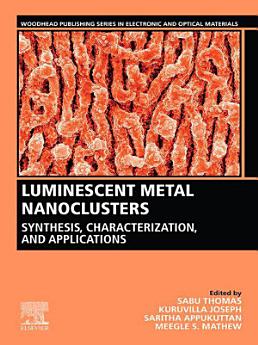
Luminescent Metal Nanoclusters: Synthesis, Characterization, and Applications

· · ·
· Woodhead Publishing
Ebook
726
Pages
Eligible

About this ebook

Luminescent Metal Nanoclusters: Synthesis, Characterization, and Applications provides a comprehensive accounting of various protocols used for the synthesis of metal nanoclusters, their characterization techniques, toxicity evaluation and various applications and future prospects. The book provides detailed experimental routes, along with mechanisms on the formation of benign metallic clusters using biomaterials and a comprehensive review regarding the preparation, properties and prospective applications of these nano clusters in various fields, including therapeutic applications. Various methods to protect nanocluster materials to increase their stability are emphasized, including the incorporation of ligands (protein, small molecule, DNA, thiols). This book addresses a gap in the current literature by bringing together the preparation, characterization and applications of all the possible types of reported metal nanoclusters and their hybrids. It is suitable for materials scientists and engineers in academia and those working in research and development in industry. It may also be of interest to those working in the interdisciplinary nanotechnology community, such as physical chemists. - Covers the most relevant material categories of luminescent nanoclusters such as metal nanoclusters, nano composites and alloy nanoclusters - Provides a comprehensive overview of the various available methods used for the protection of nanoclusters - Discusses the latest advances and future opportunities in addressing challenges in producing benign nanomaterials such as toxicity and stability
Luminescent Metal Nanoclusters: Synthesis, Characterization, and Applications provides a comprehensive accounting of various protocols used for the synthesis of metal nanoclusters, their characterization techniques, toxicity evaluation and various applications and future prospects. The book provi...

Discover more

About the author

Sabu Thomas is currently an Emeritus Professor of Mahatma Gandhi University, Kottayam, Kerala, India. He is the former Vice Chancellor of Mahatma Gandhi University and a Senior Professor of Christ University, Bangalore, India, as well as a visiting Professor at the Department of Chemical Sciences, University of Johannesburg, South Africa, Department of Chemical Engineering, Chulalongkorn University, Thailand, and an Adjunct Faculty in the Department of Polymer and Process Engineering, IIT Roorkee, India.

Kuruvilla Joseph is a Distinguished Professor in the Department of Chemistry at the Indian Institute of Space Science and Technology, Thiruvananthapuram, India. His research areas include nanomaterials and nanocomposites, polymer blends and composites, synthesis of polymers from natural resources, green materials and biocomposites, aging and degradation, and development of biosensors.

Dr. Saritha Appukuttan was awarded her PhD from Mahatma Gandhi University in 2012 working in the field of polymer nanocomposites. She has also been worked for two years on the development of gas barrier membranes on an ISRO (Indian Space Research Organization) project. She has published around 25 book chapters with highly reputed publishers and several research papers in high impact international journals such as Composites Part A, Composites Part B, and Materials Chemistry and Physics and has edited two books on “Fibre Reinforced Composites: Constituents, compatibility, perspectives and applications (Elsevier) and on “Luminescent Metal Nanoclusters (Elsevier). Currently, she is editing two more books on “Lignin and its Composites: A sustainable tool for health care and medical applications and “Zero-Dimensional Carbon Nanostructures to be published by RSC and Elsevier, respectively.

Dr Meegle S. Mathew is an Assistant Professor in the Department of Chemistry at Mar Athanasius College, India. Her research focuses on the development and application of functional nanomaterials for biomedical, energy, and environmental technologies. Her areas of expertise include nano-biophotonics, optical imaging, fluorescent nanoparticle-based biosensors and biomedical devices, polymer nanocomposites, photocatalysis, nanopriming, and photoreduction. She has conducted postdoctoral research on advanced nanomaterials and photocatalytic systems and has contributed to scholarly publications, edited volumes, book chapters, and intellectual property in these fields. Her work emphasizes the design of innovative nanomaterial-based solutions for healthcare, sustainable energy, and environmental applications.

Sabu Thomas is currently an Emeritus Professor of Mahatma Gandhi University, Kottayam, Kerala, India. He is the former Vice Chancellor of Mahatma Gandhi University and a Senior Professor of Christ University, Bangalore, India, as well as a visiting Professor at the Department of Chemical Sciences...

Rate this ebook

Tell us what you think.

Reading information

Smartphones and tablets
Install the Google Play Books app for Android and iPad/iPhone. It syncs automatically with your account and allows you to read online or offline wherever you are.
Laptops and computers
You can listen to audiobooks purchased on Google Play using your computer's web browser.
eReaders and other devices
To read on e-ink devices like Kobo eReaders, you'll need to download a file and transfer it to your device. Follow the detailed Help Center instructions to transfer the files to supported eReaders.