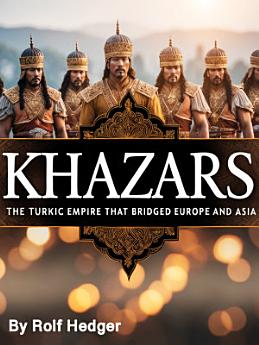
Khazars: The Turkic Empire That Bridged Europe and Asia
About this ebook
The origins of the Khazar people remain shrouded in the complex ethnic and political transformations that characterized the post-Hunnic period in Eastern Europe. Most scholars agree that the Khazars emerged from the dissolution of the Western Turkic Khaganate in the mid-seventh century, though their exact relationship to earlier nomadic confederations continues to generate scholarly debate. What is certain is that by 650 CE, the Khazars had established themselves as the dominant power in the North Caucasus region, controlling territories that stretched from the Volga River to the Dnieper and from the northern shores of the Caspian Sea to the foothills of the Caucasus Mountains.
The geographical position occupied by the Khazars was of extraordinary strategic and economic importance. Their territories controlled the vital trade routes that connected Northern Europe with Central Asia and the Middle East, including the famous route along the Volga River that linked Scandinavia with the Islamic world. This advantageous location enabled the Khazars to levy taxes on international commerce while also participating directly in long-distance trade, creating the economic foundations for a prosperity that would sustain their empire for centuries.