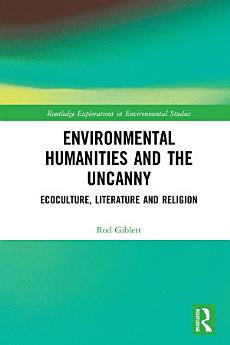
Environmental Humanities and the Uncanny: Ecoculture, Literature and Religion

· Routledge
Ebook
154
Pages
Eligible

About this ebook

Sigmund Freud’s essay 'The Uncanny' is celebrating a century since publication. It is arguably his greatest and most fruitful contribution to the study of culture and the environment. Environmental Humanities and the Uncanny brings into the open neglected aspects of the uncanny in this famous essay in its centenary year and in the work of those before and after him, such as Friedrich Schelling, Walter Benjamin, E. T. A. Hoffmann and Bram Stoker.

This book does so by focussing on religion, especially at a time and for a world in which some sectors of the monotheisms are in aggressive, and sometimes violent, contention against those of other monotheisms, and even against other sectors within their own monotheism. The chapter on Schelling’s uncanny argues that monotheisms come out of polytheism and makes the plea for polytheism central to the whole book. It enables rethinking the relationships between mythology and monotheistic and polytheistic religions in a culturally and politically liberatory and progressive way. Succeeding chapters consider the uncanny cyborg, the uncanny and the fictional, and the uncanny and the Commonwealth, concluding with a chapter on Taoism as a polytheistic religion.

Building on the author’s previous work in Environmental Humanities and Theologies in bringing together theories of religion and the environment, this book will be of great interest to students and scholars of the environmental humanities, ecocultural studies and religion.

Sigmund Freud’s essay 'The Uncanny' is celebrating a century since publication. It is arguably his greatest and most fruitful contribution to the study of culture and the environment. Environmental Humanities and the Uncanny brings into the open neglected aspects of the uncanny in this famous ess...

Discover more

About the author

Rod Giblett is Honorary Associate Professor of Environmental Humanities in the School of Communication and Creative Arts, Deakin University. He is the author of many books in the environmental humanities, including People and Places of Nature and Culture (2011) and most recently Environmental Humanities and Theologies (2018), and is a pioneer in psychoanalytic ecology.
Rod Giblett is Honorary Associate Professor of Environmental Humanities in the School of Communication and Creative Arts, Deakin University. He is the author of many books in the environmental humanities, including People and Places of Nature and Culture (2011) and most recently Environmental Hum...

Rate this ebook

Tell us what you think.

Reading information

Smartphones and tablets
Install the Google Play Books app for Android and iPad/iPhone. It syncs automatically with your account and allows you to read online or offline wherever you are.
Laptops and computers
You can listen to audiobooks purchased on Google Play using your computer's web browser.
eReaders and other devices
To read on e-ink devices like Kobo eReaders, you'll need to download a file and transfer it to your device. Follow the detailed Help Center instructions to transfer the files to supported eReaders.