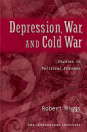
Depression, War, and Cold War: Studies in Political Economy
Jun 2006 · Oxford University Press
star
1 review
Ebook
240
Pages
Tools
info
family_home
Eligible
info
About this ebook
Other books exist that warn of the dangers of empire and war. However, few, if any, of these books do so from a scholarly, informed economic standpoint. In Depression, War, and Cold War , Robert Higgs, a highly regarded economic historian, makes pointed, fresh economic arguments against war, showing links between government policies and the economy in a clear, accessible way. He boldly questions, for instance, the widely accepted idea that World War II was the chief reason the Depression-era economy recovered. The book as a whole covers American economic history from the Great Depression through the Cold War. Part I centers on the Depression and World War II. It addresses the impact of government policies on the private sector, the effects of wartime procurement policies on the economy, and the economic consequences of the transition to a peacetime economy after the victorious end of the war. Part II focuses on the Cold War, particularly on the links between Congress and defense procurement, the level of profits made by defense contractors, and the role of public opinion andnt ideological rhetoric in the maintenance of defense expenditures over time. This new book extends and refines ideas of the earlier book with new interpretations, evidence, and statistical analysis. This book will reach a similar audience of students, researchers, and educated lay people in political economy and economic history in particular, and in the social sciences in general.
Other books exist that warn of the dangers of empire and war. However, few, if any, of these books do so from a scholarly, informed economic standpoint. In Depression, War, and Cold War , Robert Higgs, a highly regarded economic historian, makes pointed, fresh economic arguments against war, show...
Discover more
Ratings and reviews
1 review

A Google user
- Flag inappropriate
November 16, 2009
There’s a story that most Americans of my and later generations have grown up with. It goes something like this: in the late 1920’s our economy spontaneously dropped off a cliff due to an (unexplained) failure of capitalism and free enterprise. Although the situation was initially made worse by the laissez faire ideology of the Hoover administration, from 1933 onward FDR boldly enacted needed government policies to compensate for the inability of free markets to generate full employment and to self-correct. Thus government “demand” substituted for the absence of private “demand” and the grave situation was ameliorated through the 1930’s. Then World War II arrived and provided just the Keynesian stimulus the economy really needed to come out of the Great Depression once and for all. Prosperity returned with the War, and America never looked back.
Trouble is, the story is almost entirely wrong. In this collection of essays, all written well before our current crisis-driven expansion in government power, Higgs logically and systematically explodes all of the myths and provides new insights as to how the state response to the Great Depression and Second World War permanently changed both the size and dynamics of government spending in relation to the private economy, and in particular how the larger share of GDP devoted to military spending evolved through the Cold War period.
He starts with the late 1930’s and “Great Duration”: the question of why the Great Depression lasted so long, much longer than any previous downturn, even ones that were substantially deeper. In fact, it is becoming increasingly accepted in the economics profession (ok, with the exception of DeLong and Krugman) that the policies of the New Deal directly served to prolong the misery.
Higgs’ contribution to this debate is his focus on “regime uncertainty” as a deterrent to the private investment necessary to restore genuine prosperity. In FDR’s second term, the hostility to private enterprise was turned up dramatically as compared to FDR’s own policies in his first term and to his own rhetoric theretofore. Scapegoating of “economic royalists”, punitive tax rates, and ongoing battles with both a friendly Congress and an (initially) less-friendly judiciary over expansions of executive power to regulate, and a pattern of ad-hoc policy zigzagging all added up to create a genuine fear for the security of private property rights. In this environment, private capitalists were made reluctant to invest because they could not be certain or even confident in their future rights to harvest the fruits of investment. America appeared headed down the road to fascism. Thus private investment both in real dollars and as a percent of GDP remained below its pre-Depression level throughout the 1930’s and through the war years.
Higgs uses contemporaneous survey data to support the thesis that businessmen genuinely feared for the future of free enterprise. The turnaround in opinion seemed to come as FDR shifted his focus to mobilization for the war effort, beginning in 1940. There was a changing of the guard in the Administration away from the “economic planners” and towards the “dollar a year men” who came from private industry with the organizational capabilities to direct the large scale war effort that was approaching. This was a group that was friendlier to business and the focus on war mobilization led to a lessening of the open hostility to enterprise. This changing of the tone of the Administration, combined with a change in control in Congress in 1944 (and the fact that FDR was gone by the end of the war) set the stage for the “Great Escape”, the surge of private investment and return to real prosperity that ensued almost immediately after the conclusion of the war.
The poll data provided by Higgs to demonstrate these changes in the climate of opinion are corroborated by the financial markets which began to surge as the war wound down. The regime uncertainty hypothesis is thus
About the author
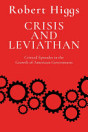
Robert Higgs is Senior Fellow in Political Economy for the Independent Institute and author of Crisis and Leviathan: Critical Episodes in the Growth of American Government.
Robert Higgs is Senior Fellow in Political Economy for the Independent Institute and author of Crisis and Leviathan: Critical Episodes in the Growth of American Government.
Rate this ebook
Tell us what you think.
Reading information
Smartphones and tablets
Install the Google Play Books app for Android and iPad/iPhone. It syncs automatically with your account and allows you to read online or offline wherever you are.
Laptops and computers
You can listen to audiobooks purchased on Google Play using your computer's web browser.
eReaders and other devices
To read on e-ink devices like Kobo eReaders, you'll need to download a file and transfer it to your device. Follow the detailed Help Center instructions to transfer the files to supported eReaders.