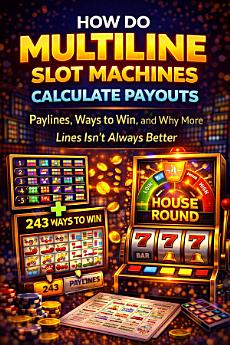
How Do Multiline Slot Machines Calculate Payouts: Paylines, Ways to Win, and Why More Lines Isn't Always Better
About this ebook
This book untangles all of it. You'll get a clear explanation of how traditional paylines work, why the number of active lines affects your bet even when it doesn't feel like it should, and what the difference is between a 20-line game at minimum bet versus a ways-to-win game at the same stake.
There's a dedicated section on 243-ways, 1024-ways, and Megaways formats — the newer structures that have largely replaced traditional paylines in modern video slots. You'll learn how wins are calculated in these formats and why the math works differently from what you'd expect based on older games.
The book also addresses the common belief that more lines equals better odds. It's not quite that simple, and this guide explains why — including how activating more lines changes your cost per spin, what it does to the frequency of winning combinations, and how to think about the trade-off between hit frequency and payout size.
Discover more
Ratings and reviews
About the author
The author is the editor of casinoonlinegaming.com greenbaycasino.com and slotbonuses.info, where they publish educational articles analyzing casino games from a mathematical and probabilistic perspective. That work focuses on game structure, probability, and common misconceptions rather than betting advice, systems, or strategies.
Writing under the Games Explained Honestly imprint, the author specializes in clear, probability-first explanations of casino games and gambling mechanics. Rather than offering methods to win or promises of outcomes, the work examines how games are designed, how probabilities are fixed, and why player experience often conflicts with mathematical reality.
The books in this series draw on publicly available information, standard principles of probability, and established concepts from game design and behavioral psychology. They are written for readers who want understanding instead of folklore, clarity instead of illusion, and explanations grounded in structure rather than belief.
The author does not provide legal advice, gambling advice, financial advice, or recommendations. All content is educational in nature and intended to help readers better interpret chance-based games and their own experiences with them.