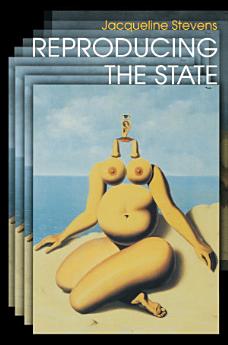
Reproducing the State
ธ.ค. 2020 · Princeton University Press
eBook
312
หน้า
family_home
มีสิทธิ์
info
เกี่ยวกับ eBook เล่มนี้
People are said to acquire their affiliations of ethnicity, race, and sex at birth. Hence, these affiliations have long been understood to be natural, independent of the ability of political societies to define who we are. Reproducing the State vigorously challenges the conventional view, as well as post-structuralist scholarship that minimizes state power. Jacqueline Stevens examines birth-based theories of membership and group affiliations in political societies ranging from the Athenian polis, to tribes of Australia, to the French republic, to the contemporary United States. The book details how political societies determine the kinship rules that are used to reproduce political societies.
Stevens analyzes the ways that ancestral and territorial birth rules for membership in political societies pattern other intergenerational affiliations. She shows how the notion of ethnicity depends on the implicit or explicit invocation of a past, present, or future political society. She also shows how geography is used to represent political regions, including continents, as the seemingly natural underpinning for racial taxonomies perpetuated through miscegenation laws and birth certificates. And Stevens argues that sex differences are also constituted through membership practices of political societies. In its chronological and disciplinary range, Reproducing the State will reward the interest of scholars in many fields, including anthropology, history, political science, sociology, women's studies, race studies, and ethnic studies.
Stevens analyzes the ways that ancestral and territorial birth rules for membership in political societies pattern other intergenerational affiliations. She shows how the notion of ethnicity depends on the implicit or explicit invocation of a past, present, or future political society. She also shows how geography is used to represent political regions, including continents, as the seemingly natural underpinning for racial taxonomies perpetuated through miscegenation laws and birth certificates. And Stevens argues that sex differences are also constituted through membership practices of political societies. In its chronological and disciplinary range, Reproducing the State will reward the interest of scholars in many fields, including anthropology, history, political science, sociology, women's studies, race studies, and ethnic studies.
People are said to acquire their affiliations of ethnicity, race, and sex at birth. Hence, these affiliations have long been understood to be natural, independent of the ability of political societies to define who we are. Reproducing the State vigorously challenges the conventional view, as well...
สำรวจหนังสือเล่มอื่นๆ
เกี่ยวกับผู้แต่ง
Jacqueline Stevens is the Johnson Visiting Assistant Professor of Politics at Pomona College, where she teaches political theory.
Jacqueline Stevens is the Johnson Visiting Assistant Professor of Politics at Pomona College, where she teaches political theory.
ให้คะแนน eBook นี้
แสดงความเห็นของคุณให้เรารับรู้
ข้อมูลในการอ่าน
สมาร์ทโฟนและแท็บเล็ต
ติดตั้งแอป Google Play Books สำหรับ Android และ iPad/iPhone แอปจะซิงค์โดยอัตโนมัติกับบัญชีของคุณ และช่วยให้คุณอ่านแบบออนไลน์หรือออฟไลน์ได้ทุกที่
แล็ปท็อปและคอมพิวเตอร์
คุณฟังหนังสือเสียงที่ซื้อจาก Google Play โดยใช้เว็บเบราว์เซอร์ในคอมพิวเตอร์ได้
eReader และอุปกรณ์อื่นๆ
หากต้องการอ่านบนอุปกรณ์ e-ink เช่น Kobo eReader คุณจะต้องดาวน์โหลดและโอนไฟล์ไปยังอุปกรณ์ของคุณ โปรดทำตามวิธีการอย่างละเอียดในศูนย์ช่วยเหลือเพื่อโอนไฟล์ไปยัง eReader ที่รองรับ


