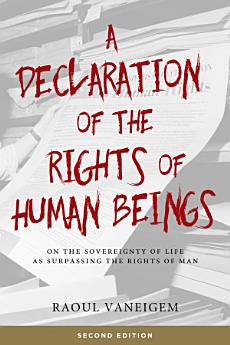
Declaration of the Rights of Human Beings: On the Sovereignty of Life as Surpassing the Rights of Man
About this ebook
Sometimes playful or poetic, always provocative, Vaneigem reviews the history of bills of rights before offering his own call, with commentary, for fifty-eight rights yet to be won in a world where the “freedoms accorded to Man” are no longer merely “the freedoms accorded by man to the economy.”
Every human being has the right, for example: to become human and to be treated as such; to dispose freely of their time; to comfort and luxury; to free modes of transport set up by and for the collectivity; to permanent control over scientific experimentation; to association by affinity; to bend toward life what was turned toward death; to the flux of passions and the freedoms of love; to a natural life and a natural death; to hold nothing sacred; to excess and to moderation; to desire what seems beyond the realm of the possible.
Readers of Vaneigem’s now-classic work The Revolution of Everyday Life will find much to engage with in this unique work of subversive utopianism.
Discover more
About the author
Born in 1934, Raoul Vaneigem is a writer and a former member of the Situationist International and was a key theorist in the worldwide Occupy movement. His works include A Letter to My Children and the Children of the World to Come, The Book of Pleasures, A Cavalier History of Surrealism, Contributions to the Revolutionary Struggle, and the globally influential text The Revolution of Everyday Life.
Liz Heron is a Scottish writer and translator living in London. Her many other translations include Artemisia: A Novel by Alexandra Lapierre; Infancy and History by Giorgio Agamben; and The Unseen by Nanni Balestrini. She has anthologized women’s fiction on cities in Streets of Desire (1993); published her own short stories as Red River (1996); and her latest novel is The Hourglass (2018).