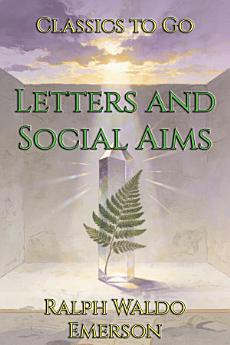
Letters and Social Aims: Restored Classics to Go Edition

· Otbebookpublishing
Ebook
275
Pages
Eligible

About this ebook

In this luminous meditation on mind, nature, and art, Emerson argues that common sense is necessary, but never final: beneath the practical laws of material life lies a world of deeper correspondences, moral purpose, and continual transformation. Science, from chemistry and geology to botany and anatomy, becomes evidence that the universe is symbolic, woven together by hidden unity that the imaginative mind can perceive. Emerson insists that facts matter most when they become signs of larger truths, and that poetry is the miracle of turning ordinary life into revelation. He presents imagination as a joyful, elevating power shared by all people, even when they deny it, and defines the true poet as a healthy, spiritually alert visionary who sees moral and natural relations rather than mere surface likenesses. Figures such as Goethe, Dante, Shakespeare, and Blake embody this union of insight and form. Alongside this celebration of poetic vision, Emerson turns to comedy and wit as moral correctives: laughter exposes hypocrisy, false religion, pedantry, and social pretension whenever outward forms are mistaken for inward truth. The result is a rich, searching portrait of human consciousness striving to read the world rightly and live by what it discovers. This edition has been fully restored with modern typesetting, custom cover design.
In this luminous meditation on mind, nature, and art, Emerson argues that common sense is necessary, but never final: beneath the practical laws of material life lies a world of deeper correspondences, moral purpose, and continual transformation. Science, from chemistry and geology to botany and ...

About the author

Ralph Waldo Emerson was a defining voice of nineteenth-century American thought, a writer, lecturer, and philosopher whose life traced the making of a distinctly American literary identity. Born in Boston in 1803 and educated at Harvard, he began his career as a Unitarian minister before a crisis of conviction led him away from the pulpit and toward a life of public reflection, travel, and writing. From the circles of New England intellectual life he emerged as the central figure of Transcendentalism, shaping essays, lectures, and poems that encouraged readers to trust intuition, nature, self-reliance, and the dignity of the individual mind. His work helped establish the essay as a major American literary form, and his influence extended across generations of writers, reformers, and thinkers who found in him a model of moral independence and spiritual seriousness. Emerson's writing often returns to the tension between society and the self, urging people to resist conformity while remaining alert to the ethical demands of community, a balance that still feels urgent in an age of noise, pressure, and constant public performance. He wrote with clarity, aphoristic force, and a deep faith in human possibility, making his ideas accessible even when they were lofty. Today, Emerson remains significant because he speaks to readers searching for purpose, resilience, and a more authentic way to live. His legacy endures in American literature, philosophy, and self-understanding, and he is especially rewarding for readers interested in ideas about individuality, nature, civic life, and the inner life of the mind.
Ralph Waldo Emerson was a defining voice of nineteenth-century American thought, a writer, lecturer, and philosopher whose life traced the making of a distinctly American literary identity. Born in Boston in 1803 and educated at Harvard, he began his career as a Unitarian minister before a crisis...

Rate this ebook

Tell us what you think.

Reading information

Smartphones and tablets
Install the Google Play Books app for Android and iPad/iPhone. It syncs automatically with your account and allows you to read online or offline wherever you are.
Laptops and computers
You can listen to audiobooks purchased on Google Play using your computer's web browser.
eReaders and other devices
To read on e-ink devices like Kobo eReaders, you'll need to download a file and transfer it to your device. Follow the detailed Help Center instructions to transfer the files to supported eReaders.