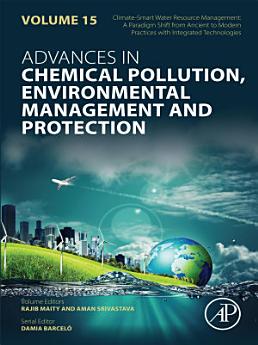
Climate-Smart Water Resource Management: A Paradigm Shift from Ancient to Modern Practices with Integrated Technologies

·
· Advances in Chemical Pollution, Environmental Management and Protection Book 15 · Academic Press
Ebook
308
Pages
Eligible

About this ebook

This volume presents a transformative vision for water resource management in an era of climate uncertainty, bridging millennia-old indigenous wisdom with cutting-edge technologies. Climate-Smart Water Resource Management: A Paradigm Shift from Ancient to Modern Practices with Integrated Technologies brings together sixteen chapters that span foundational concepts, artificial intelligence and machine learning frontiers, geospatial and remote sensing applications, and a forward-looking synthesis. From the time-tested bamboo irrigation networks and paddy-cum-fish cultivation of the Apatani tribe in the Indian Himalayas to the use of Sentinel‐1 SAR for flood inundation mapping, from entropy-based precipitation complexity analysis to bidirectional LSTM networks for streamflow forecasting, and from Large Language Models reimagining stakeholder engagement to LiDAR-enabled precision topography – this volume demonstrates how the integration of traditional ecological knowledge with AI‐ML, RS‐GIS, and LLMs can forge climate-resilient, equitable, and sustainable water futures. Designed for researchers, policymakers, practitioners, and students, the book provides both theoretical depth and implementable strategies, culminating in a call for interdisciplinary collaboration and policy innovation. It is an essential compendium for anyone committed to reimagining how humanity governs its most precious resource in a rapidly changing world. - Bridges ancient wisdom with modern AI‐ML, RS‐GIS, and LLMs – from Apatani tribal practices to flood mapping and streamflow forecasting. - Covers diverse real‐world applications – rainfall/streamflow prediction, water quality assessment, watershed prioritization, and aquaculture management. - Provides implementable synthesis and policy directions – distills cross‐cutting themes and calls for equitable, technology‐driven water governance.
This volume presents a transformative vision for water resource management in an era of climate uncertainty, bridging millennia-old indigenous wisdom with cutting-edge technologies. Climate-Smart Water Resource Management: A Paradigm Shift from Ancient to Modern Practices with Integrated Technolo...

Discover more

About the author

Prof. (Dr.) Rajib Maity is a professor and AK Singh Chair faculty in the Department of Civil Engineering, Indian Institute of Technology Kharagpur (IIT Kharagpur), India. He is also a Fellow of the Royal Meteorological Society, UK. He is currently heading the School of Water Resources at IIT Kharagpur as the Chairperson of the school. His research areas include Hydroclimatology, Climate Change Impact on Water Resources, Stochastic Hydrology, Analysis of Hydroclimatic Extremes, Hydrologic Time Series Analyses and Forecasting, Sea Level Rise, Remote Sensing Applications in Hydrology, and AI/ML applications in Hydroclimatology. Apart from AK Singh Chair Faculty and Fellow of the Royal Meteorological Society, his other professional recognitions include Humboldt Fellowship (Experienced Researchers, Germany), James Rennell MoES Young Fellow (MoES, GoI) Faculty Excellence Award (IIT Kharagpur), Prof. R. J. Garde Research Award (ISH, India), Emerging Leaders Fellowship (Australia), BOYSCAST Fellowship, IEI Young Engineers Award, DAAD Fellowship (Germany), International ICE WaRM Fellowship (Australia), and Prof. N. S. Govinda Rao Memorial Medal from Indian Institute of Science, Bengaluru. Prof. Maity has published two books and more than 235 research articles in different peer reviewed journals and conferences and chapters in books. Prof. Maity also serves as Guest Editor and Associate Editor of several international journals, including Journal of Hydrology (Elsevier), Scientific Reports (Nature Portfolio Journal), Journal of Hydrologic Engineering (ASCE), etc. For recent updates, please visit https://facweb.iitkgp.ac.in/~rajibmaity/.

Dr. Aman Srivastava is currently an Institute Post‐Doctoral Fellow (IPDF) at the Public Policy and Economics Division of the Department of Humanities and Social Sciences at Indian Institute of Technology (IIT) Madras. Previously, he served as a Post‐Doctoral Researcher in the Department of Ocean Engineering, IIT Madras, and as a Project Scientist at the Centre for Circularity (CRRET), IIT Madras. He earned his Ph.D. from the Department of Civil Engineering, IIT Kharagpur, as a Prime Minister’s Research Fellow (PMRF). His doctoral research pioneered a fifth classification of drought—Environmental Drought—and developed a first‐of‐its‐kind Environmental Drought Index (EDI) published in the prestigious Journal of Hydrology. Dr. Srivastava also holds a Master’s degree (M. Tech.) from the Centre for Technology Alternatives for Rural Areas (CTARA) at IIT Bombay, where he graduated as the overall topper and received the Institute Medal Award from Nobel Laureate Prof. Duncan Haldane. His research interests span climate change adaptation and mitigation, water resources engineering and management, and public policy and governance, with a publication record comprising several journal articles, patent, book chapters, and international conference papers. His professional experience includes serving as a Research Associate with the Ministry of Rural Development, a Research in Development Fellow with Hindustan Aeronautics Limited (HAL), and a Visiting Faculty member in Civil Engineering at Government College of Engineering, Nagpur (India).


Prof. (Dr.) Rajib Maity is a professor and AK Singh Chair faculty in the Department of Civil Engineering, Indian Institute of Technology Kharagpur (IIT Kharagpur), India. He is also a Fellow of the Royal Meteorological Society, UK. He is currently heading the School of Water Resources at IIT Khar...

Rate this ebook

Tell us what you think.

Reading information

Smartphones and tablets
Install the Google Play Books app for Android and iPad/iPhone. It syncs automatically with your account and allows you to read online or offline wherever you are.
Laptops and computers
You can listen to audiobooks purchased on Google Play using your computer's web browser.
eReaders and other devices
To read on e-ink devices like Kobo eReaders, you'll need to download a file and transfer it to your device. Follow the detailed Help Center instructions to transfer the files to supported eReaders.