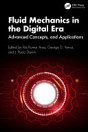
About this ebook
• Discusses fluid-structure interaction (FSI) in Industry 4.0, biofluid mechanics in medical applications, and fluid-induced vibration.
• Illustrates fluid mechanics in microgravity and space applications, big data, and analytics in fluid mechanics.
• Showcases how fluid mechanics plays a crucial role in diverse applications, such as space travel, medical advancements, and environmental solutions.
• Explores how digital technologies like the Internet of Things (IoT), artificial intelligence (AI), and data analytics merge with fluid dynamics.
• Offers problem-solving tools and strategies showcasing how fluid mechanics can address challenges ranging from noise reduction in machinery to efficient energy usage.
The text is primarily written for senior undergraduates, and graduate students in diverse fields including mechanical engineering, industrial engineering, manufacturing engineering, chemical engineering, aerospace engineering, structural engineering, civil engineering, and automotive engineering.
Discover more
About the author
Raj Kumar Arya is an associate professor in the Department of Chemical Engineering, at Dr B. R. Ambedkar National Institute of Technology, Jalandhar, India. His areas of research include thin film polymeric coatings, antimicrobial coatings, finite element formulation, modeling and simulation using MATLAB, anticorrosion coatings, anti-fouling coatings, and confocal Raman spectroscopy. He has published over 100 research papers in journals and conferences of national and international repute.
George D. Verros is a Fellow in the Department of Chemistry, at Aristotle University of Thessaloniki, Greece. His primary interests are polymer science and technology with an emphasis on process simulation, mathematical modeling, online optimization, calculation of molecular weight distribution in polymerization reactors, diffusion-controlled reactions, nanocomposites, membrane, and coating formation. He is the author or co-author of about 50 publications in scientific journals and has written more than 60 publications in proceedings of conferences.
J. Paulo Davim is a full professor at the University of Aveiro, Portugal. He is also distinguished as an honorary professor in several universities/colleges/institutes in China, India, and Spain. He is a senior chartered engineer by the Portuguese Institution of Engineers with an MBA and specialist titles in engineering and industrial management as well as in metrology. He has more than 35 years of teaching and research experience in manufacturing, materials, mechanical, and industrial engineering, with a special emphasis on machining, and tribology.