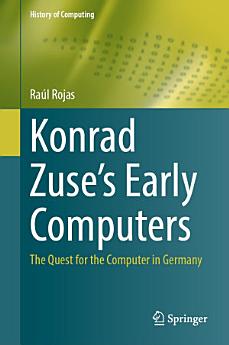
Konrad Zuse's Early Computers: The Quest for the Computer in Germany

· Springer Nature
Ebook
229
Pages

About this ebook

This book describes the historical development of the architectures of the first computers built by the German inventor Konrad Zuse in Berlin between 1936 and 1945. Zuse's machines are historically important because they anticipated many features of modern computers. Specifically, these include the separation of processor and memory, the ability to compute with floating-point numbers, a hardware architecture based on microprogramming of the instruction set, and a layered design with a high-level programming language on top. In fact, Zuse's early computers are closer to modern computers than the Harvard Mark I or ENIAC, two other contenders for the title of "world's first computer." The theoretical program first conceived by Zuse in 1936/37 was fulfilled with a series of machines built before and during World War II: the Z1, Z2, Z3, and Z4. Separate chapters deal with the architecture of each computer, culminating in the description of Plankalkül, the first proposal for a high-level programming language.

Students of the sciences and practitioners of computer science should have no trouble following the material. The concise introductory summary sets the reader on the historical path to retrace this remarkable intellectual adventure.

This book describes the historical development of the architectures of the first computers built by the German inventor Konrad Zuse in Berlin between 1936 and 1945. Zuse's machines are historically important because they anticipated many features of modern computers. Specifically, these include t...

Discover more

About the author

Raul Rojas is Professor of Mathematics and Statistics at the University of Nevada, Reno. He was Professor of Artificial Intelligence at the Freie Universität Berlin from 1997 to 2020. Previously, he held professorships at the Martin Luther University Halle-Wittenberg and the Technical University of Vienna. Raul Rojas' field of research is the theory and applications of artificial intelligence algorithms. He has published two books on neural networks with Springer-Verlag, as well as the book “Die Rechenmaschinen von Konrad Zuse” (1998), a volume that finds its continuation in this new book. Prof. Rojas is a member of the Mexican Academy of Sciences, received the National Science Prize of Mexico in 2015, and was named Professor of the Year in Germany in 2014.
Raul Rojas is Professor of Mathematics and Statistics at the University of Nevada, Reno. He was Professor of Artificial Intelligence at the Freie Universität Berlin from 1997 to 2020. Previously, he held professorships at the Martin Luther University Halle-Wittenberg and the Technical University ...

Rate this ebook

Tell us what you think.

Reading information

Smartphones and tablets
Install the Google Play Books app for Android and iPad/iPhone. It syncs automatically with your account and allows you to read online or offline wherever you are.
Laptops and computers
You can listen to audiobooks purchased on Google Play using your computer's web browser.
eReaders and other devices
To read on e-ink devices like Kobo eReaders, you'll need to download a file and transfer it to your device. Follow the detailed Help Center instructions to transfer the files to supported eReaders.