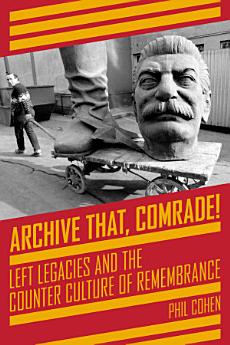
Archive That, Comrade!: Left Legacies and the Counter Culture of Remembrance
About this ebook
After a brief introduction that sets the contemporary scene of ‘archive fever,’ the book considers what the political legacy of 1960s counter culture reveals about the process of commemoration. The argument then opens out to discuss the notion of historical legacy and its role in the ‘dialectic of generations’. How far can the archive serve as a platform for dialogue and debate between different generations of activists in a culture that fetishises the evanescent present, practices a profound amnesia about its past, and forecloses the sociological imagination of an alternative future? The following section looks at the emergence of a complex apparatus of public fame and celebrity around the spectacle of dissidence and considers whether the Left has subverted or merely mirrored the dominant forms of reputation-making and public recognition. Can the Left establish its own autonomous model of commemoration?
The final section takes up the challenge of outlining a model for the democratic archive as a revisionary project, creating a resource for building collective capacity to sustain struggles of long duration. A postscript examines how archival strategies of the alt-right have intervened at this juncture to elaborate a politics of false memory.
Discover more
About the author
Phil Cohen played a key role in the London counter culture scene of the 1960s. As “Dr John” he was the public face of the London street commune movement and the occupation of 144 Piccadilly in July 1969. He subsequently became an urban ethnographer, and for the past forty years he has been involved with working-class communities in East London documenting the impact of structural and demographic change on their livelihoods, lifestyles, and life stories. Currently he is research director of Livingmaps, a network of activists, artists, and academics developing a creative and critical approach to social mapping. He is also a professor emeritus at the University of East London and a research fellow of the Young Foundation.